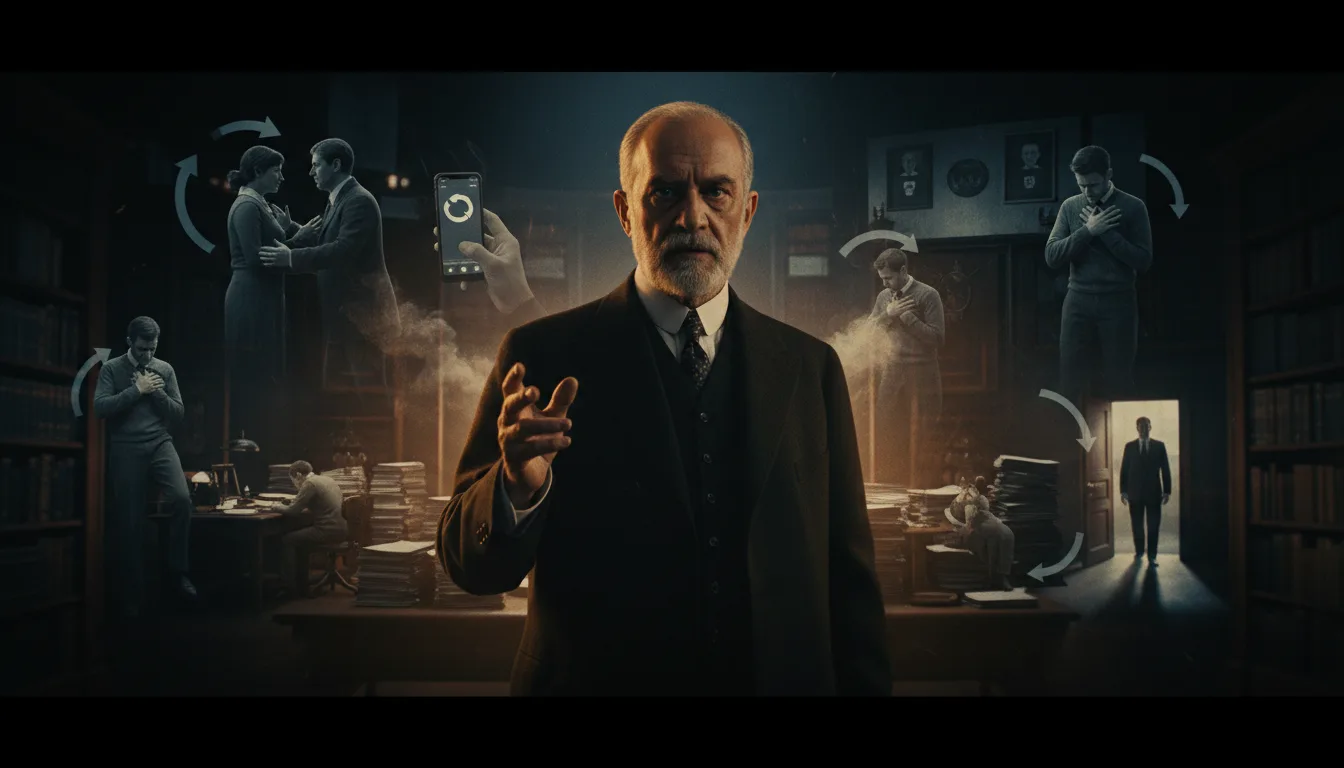
Not everything that destroys us looks like destruction.
Sometimes it arrives disguised as responsibility. Other times it takes the name of prudence, loyalty, patience, sacrifice or commitment. It can even look like a virtue for years. We keep holding a situation together because we believe it is the right thing to do, we stay by someone's side because leaving feels like a betrayal, and we keep working in a certain way because everyone expects us to be able to fix everything.
Until one day we discover that what we thought we were holding together was consuming us.
And the most disconcerting part is not only the exhaustion, but the inertia: the fact of having stayed even when there were already enough signs to leave.
Then a difficult question appears: if we human beings want to live better, why do we repeat behaviors whose outcome we already know? Why do we mentally return to those who disappointed us? Why do we maintain relationships, routines or ways of living that wear us down? Why is it so hard to abandon what, in theory, we want to leave behind?
Sigmund Freud tried to answer these questions through one of his most controversial ideas: the death drive.
Freud and the repetition of suffering
Before formulating the death drive, Freud had already observed something disconcerting during the treatment of his patients: many people did not merely remember their conflicts — they repeated them.
They reproduced old relationships in their current bonds. They placed themselves again in similar situations. They chose different people with whom they ended up living practically the same story. Whatever could not be remembered, understood or worked through appeared again, turned into behavior.
And the most unsettling part is that, in many cases, this repetition was neither conscious nor sought. There was no clear decision to "suffer again", but rather a kind of inner script that activated itself over and over.
After the First World War, the question took on an even more disturbing dimension. Some traumatized soldiers relived in their dreams the scenes that had caused them the most pain. If our mind were governed solely by the pursuit of pleasure and the avoidance of suffering, why reproduce something unbearable again and again?
In 1920, Freud published Beyond the Pleasure Principle. There he developed the idea of a "repetition compulsion": a tendency to reproduce painful experiences that seemed to impose itself even when there was no evident satisfaction.
Freud went on to describe people whose friendships always ended in betrayal, benefactors who ended up abandoned by those they had helped, or love relationships that ran through the same phases over and over. Those people might feel they were victims of an evil fate, but Freud suspected that part of that fate was being unconsciously rebuilt by themselves.
From that observation he formulated a far more ambitious hypothesis: alongside the forces that unite, preserve and develop life, there might exist another tendency oriented toward reduction, disintegration and the return to an earlier state. That force would be what we would later come to know as the death drive.
It was a bold idea. Also a deeply speculative one.
Freud himself warned that he was moving away from empirical observation and entering a territory where part of the reasoning could turn out to be excessively adventurous. The death drive was never demonstrated as if it were a biological law. It remains a hypothesis that is debated, reinterpreted and rejected by numerous authors. Contemporary psychology can explain many destructive repetitions through trauma, learning, habits, attachment, emotional regulation or early experiences, without needing to accept the literal existence of an inner force oriented toward death.
However, a theory can fail to be scientifically conclusive and still contain a metaphor capable of illuminating certain corners of our experience.
And perhaps that is where this idea retains all its strength.
It doesn't always mean wanting to die
Here is a misinterpretation that must be made clear in this article. When we speak of the death drive, it is easy to imagine something extreme: a conscious desire to disappear, to destroy oneself or to hurt oneself. But that interpretation is too simple and can lead us to the wrong conclusions.
The death drive, understood as a metaphor for everyday life, can manifest itself in a much quieter way. In very many cases it is about the subject's desire "not to feel", and this does not have to be linked to a desire for death. I believe all of us, at some point, have needed those moments of "not feeling", and in fact I consider them to be even necessary — they can be effective tools for returning to much more cheerful states of mind, supposedly inherent to the human condition.
It can appear when we stay in a relationship sustained solely by resentment. When we turn a disappointment into the center of our identity. When we work ourselves to exhaustion because we need to prove we are still indispensable. When we reject an opportunity because failing would confirm our fears, but succeeding would force us to become someone different. When we choose, again and again, people incapable of offering us what we need, and then interpret their behavior as further proof that no one is worthy of trust.
We do not always seek suffering. Often we seek something familiar.
And the familiar, even when it hurts, can seem safer than what we do not yet know how to inhabit.
This is one of the hardest paradoxes to accept: some people do not remain in painful situations because they enjoy them, but because those situations fit the image they have built of themselves. Known pain has rules. Freedom, on the other hand, forces us to improvise.
Changing means giving up an identity. Ceasing to be the one who endures, the one who rescues, the one who can always handle everything, the one who never leaves, or the one who needs to permanently prove their worth. And even if that identity is destroying us, it continues to provide us with a way of recognizing ourselves. This change — giving up one's own identity — should not be understood as a change that endures over time; rather, it can often serve as a tool to return to the emotional state we understand as "normal".
Sometimes even a form of coherence: "this is me, even if it hurts me". It can be tremendously revealing. This statement about oneself may, perhaps, hold the key to authentic well-being.
Perhaps that is why some wounds resist closing so much. Without them we would have to answer a question that can be more frightening than suffering itself:
Who am I when I no longer need to defend myself from what happened?
When disappointment fills the whole room
Some wounds do not come from strangers, but from people from whom we expected loyalty, gratitude, good faith or a minimal reciprocation of the trust we had placed in them.
Those disappointments have a particularity: they do not only modify the present. They also force us to review the past.
One mentally returns to old conversations, interprets gestures that went unnoticed at the time, and wonders whether the relationship one believes to have lived ever existed in the way one remembers it. It is as if someone suddenly changed the lighting of a familiar room and all its objects began to cast different shadows.
Then repetition appears.
We go over a conversation looking for a phrase that escaped us. We reconstruct a situation imagining what we should have answered. We mentally rehearse explanations we will never receive. Each turn seems to promise a definitive understanding, but almost always leaves us in the same place.
The mind tries to solve the past as if it were still modifiable.
And while it tries, it can end up granting the person who disappointed us a much greater presence than they deserve. The person may no longer be there, but they continue to occupy an inner room. We have handed them a key and, without realizing it, we are the ones still paying the rent — and at what a price!
The most unfair thing is that disappointments usually make much more noise than the everyday faithfulness of those who stay. Loyal people do not burst in. They do not need to prove every morning that they are still there. Their presence integrates into our life so naturally that we run the risk of considering it inexhaustible.
Disappointment, on the other hand, breaks something.
And everything that breaks immediately claims our attention.
Perhaps that is why our emotional balance does not always tip toward what carries the most weight, but toward what fell upon it with the greatest violence.
The life we build and the life we choose
There is another, less visible form of repetition: moving forward for years along a path we never fully chose.
Some people grew up carrying a blueprint under their arm, even though they had not drawn it. They learned early what was expected of them, what profession they should practice, what responsibilities they had to assume and which version of themselves would receive the recognition of others.
Sometimes those expectations came from love. But burdens imposed with affection are still burdens, even if it takes us much longer to dare to call them that.
One can walk that path correctly. One can excel, gain recognition and experience the legitimate satisfaction of doing one's job well. But one can also become excellent at a life and keep wondering whether that life was truly one's own.
Success does not always resolve the question of vocation. Sometimes it only manages to postpone it.
And what is postponed does not disappear: it accumulates.
When we finally try to recover an abandoned part of ourselves, we may do it desperately. We want to compensate for the lost years all at once. We look for in an activity, a relationship or a new identity the intensity we no longer find in everyday life.
And an escape can look like freedom if it has a good enough soundtrack.
The problem appears when what we use to escape begins to decide who comes back home afterwards.
The solitude that protects and the one that devours
At certain moments, solitude can become a legitimate refuge. When every conversation seems to demand an energy that is no longer easily recovered, silence offers rest. An empty room asks for no explanations, demands no answers and does not force us to pretend that every gesture costs less than it really costs.
But even refuges must have doors.
Solitude can protect us from the noise while we recover our strength, but it can also slowly transform into the place from which we justify our withdrawal from the world. We can convince ourselves that we need no one when, in reality, what we fear is being disappointed again.
Isolation avoids new wounds, but it also prevents new experiences.
And the death drive, understood in this symbolic way, may not consist in wishing to cease to exist, but in gradually reducing our participation in existence. Stopping calling. Stopping creating. Stopping trusting. Stopping hoping. Stopping exposing ourselves to anything that might hurt, even if in doing so we must also give up everything that could give us back a part of life.
One must not confuse, however, a philosophical reflection with a diagnosis. Depression is not simply a lack of willpower, nor can it be explained solely through the Freudian idea of the death drive. When loss of interest, exhaustion, hopelessness or difficulty functioning persist over time, they deserve professional attention. Asking for help does not invalidate personal reflection; it can be precisely the decision that prevents the darkness from continuing to advance inside the walls.
Questioning the repetition
I do not know whether the death drive exists exactly as Freud imagined it. Nor do I need to accept his entire theory to recognize the question it contains.
Why do we return to what hurts us?
Perhaps the first step is not to fight that force, but to recognize the forms it takes. To ask ourselves what situation we are repeating, what honorable explanation we use to maintain it, and what part of our identity depends on nothing changing.
It can also be useful to ask ourselves what we obtain from what harms us.
The answer is usually not pleasure. It can be security, familiarity, avoiding a conflict, not disappointing someone, preserving an image of ourselves, or continuing to feel needed. Every persistent behavior serves some function, even if the price we pay has ended up being disproportionate.
Then an even more uncomfortable question arrives:
What would I have to do today if I stopped expecting the past to be different?
Perhaps we cannot transform our life immediately. But we can interrupt one concrete repetition. Not answering impulsively. Not reopening a conversation that only feeds resentment. Asking for help. Resting without turning rest into a definitive withdrawal. Recognizing those who stay. Recovering an activity that serves to prove nothing. Setting a small limit where we have always offered unlimited availability.
The life drive does not have to manifest itself through grand gestures either.
Sometimes it consists simply of taking a shower, opening a window, answering a loved one, going out for a walk, picking up an instrument again, or allowing someone to accompany us without demanding a perfect explanation from ourselves.
From the uncomfortable place
I plan to expand these reflections in a book. Not to prove that Freud was right nor to present a new psychological theory, but to try to understand why certain wounds acquire more strength than the affections that remain, and why we can learn to live with pain until we confuse it with our identity.
It will be a book written from an uncomfortable place.
From the experience of realizing that one can have valuable things and yet feel that the world is broadcasting on a frequency one can no longer tune into. From the need to understand why some disappointments occupy so much space. From the solitude that sometimes protects and at other times threatens to close all the doors.
But this article does not intend to anticipate that book nor to resolve questions that will probably need many more pages.
Its intention is more modest.
If someone recognizes here a repetition of their own, perhaps they can stop before walking the same path once again. If someone understands that their tiredness is not a moral failing, perhaps they will stop treating themselves so harshly. If some person discovers that a wound is part of their story but does not have to become their entire identity, these words will have served a purpose.
One single person is enough for me.
Because a dark force loses part of its power when we manage to name it. And perhaps we cannot prevent it from existing, but we can learn to recognize when it begins to speak in our name.
A tool can help us put the map in order.
The path, however, we will have to walk ourselves.
Editorial note and related reading
This article is a personal, interpretive reflection on a historical hypothesis of psychoanalysis. It does not constitute psychological advice and is no substitute for the help of a mental health professional. If you are going through a difficult time, talking to a specialist can be the first step toward interrupting the repetition.
If you found this reflection interesting, you may also want to read Sisyphus and the eternal repetition: the myth that explains why we repeat ourselves, Stoicism in the 21st century: serenity in the face of what we cannot control and Carl Jung and artificial intelligence: the unconscious that inhabits us.