The Myth and Its Relevance
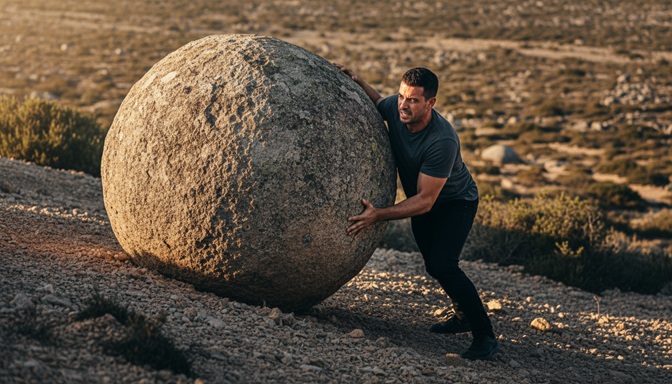
Sisyphus, according to Greek tradition, was a cunning king who deceived the gods and, for this, received an eternal punishment: pushing a rock to the top of a mountain, only to watch it roll back down. Every day, the same ascent. Every day, the same descent. Every day, starting over.
For centuries, this myth was read as the perfect image of the absurd: effort without result, task without meaning, life without purpose. But there were those who saw something different in Sisyphus. Albert Camus, in his essay The Myth of Sisyphus (1942), proposed a radical reading: 'One must imagine Sisyphus happy.'
Happy? Can a man condemned to eternally push a rock be happy? Camus said yes. Not because his task had a result, but because he had decided to make it his own. And therein lies the great lesson of the myth: we cannot always choose the rock we must push, but we can choose how we push it.
Today, in the 21st century, the myth of Sisyphus seems more relevant than ever. We live in a time where many people feel they are pushing invisible rocks: jobs that repeat without clear progress, relationships that seem stagnant, personal efforts that don't bear immediate fruit. And yet, we keep pushing.
This article is not about motivating you to keep pushing without thinking. It's about inviting you to think about how you push, what meaning you give to that effort, and how you can find something resembling happiness—or at least peace—amid the repetition.
When the Myth Becomes Personal
You don't need to be a Greek king to feel like Sisyphus. In fact, many everyday lives have something Sisyphean about them without anyone noticing. The father who works to pay bills, only for new bills to arrive the next month. The mother who cleans, cooks, tidies, only for everything to become disordered again the next day. The student who studies for one exam, then another, then another, not knowing if all that effort will lead anywhere concrete.
Often, modern life feels like a wheel that spins without rest. The email inbox that empties only to fill up again. The to-do list that gets completed only to extend the next day. The effort that seems to have no end, no clear reward, no applause. Only the certainty that tomorrow you'll have to start again.
And yet, there is something profoundly human in that. Because if you think about it, life itself is repetition. We breathe to breathe again. We eat to be hungry again. We sleep to wake up again. All life is, in a way, a cycle. And accepting that—without despair—is a form of wisdom.
Sisyphus in the Modern Era: Work, Technology, and the Illusion of Progress
If the Greeks saw in Sisyphus a divine punishment, we might see in him a symbol of modern work. Many professions today are Sisyphean by nature: repetitive, alienating, without a clear meaning beyond subsistence.
Think of the office employee who generates reports that no one reads. The factory worker who assembles pieces without knowing what they're for. The digital content creator who uploads videos, photos, texts into the infinite void of the internet, hoping that someone, somewhere, will pay attention. We all push digital, bureaucratic, emotional rocks.
But there's more: technology, which promised to free us from repetitive work, has often only multiplied it. Before, you answered one letter a month. Now, you answer fifty emails a day. Before, you worked in a physical place and then went home. Now, work follows you on your phone, on your laptop, in every notification that vibrates in your pocket.
And the cruelest part: they sell us the idea that if we push faster, harder, more efficiently, someday we'll reach the top and the rock will stay still. But it doesn't stay still. It never does. Because the system is designed for you to keep pushing.
So what do we do? Stop pushing? Rebel? Maybe not. Maybe the lesson isn't to stop pushing, but to change our relationship with the rock. Change our way of climbing.
Contemporary Examples of the Myth: When the Rock Has a Name
We all carry a different rock. Some are visible, others are not. Some weigh tons, others are lighter but equally exhausting. Here are some concrete examples of how the myth of Sisyphus manifests today:
The person with a chronic illness, who every day must manage symptoms, medication, fatigue. There is no cure, only management. Every day is an ascent. Every day, the rock is back at the foot of the mountain.
The entrepreneur who tries again and again to move a project forward. Each attempt seems promising. Each failure returns them to the starting point. And yet, they try again. Why? Because they have decided that this is their rock, and that it's worth pushing.
The caregiver of a dependent person—a child with disabilities, a parent with dementia—who every day repeats the same routines: feeding, washing, accompanying. There is no happy ending, no external reward. Only the act of caring, again and again.
The artist who creates without recognition. Who paints, writes, composes, not because it will make them famous, but because they need to do it. Each work is a rock that goes up and comes back down. But in the process, something transforms.
All these examples have something in common: there is no 'ending.' There is no day when the rock stays at the top and everything is resolved. There is only the decision to continue. And that decision, made consciously, is what turns the absurd into dignity.
As Viktor Frankl, Auschwitz survivor and creator of logotherapy, wrote: 'Those who have a why to live, can bear with almost any how.' Sisyphus, deep down, found his why. Not at the top, but in the climb. And that why wasn't given to him by anyone. He gave it to himself. Every day. Every time he pushed again, he did so saying: this rock is mine, this effort is mine, and today I will climb it my way.
The Deep Teaching of the Descent: The Moment of Consciousness
The most poetic part of the myth is not the ascent. It's the descent. That moment when Sisyphus goes down the mountain, alone, in silence, knowing he will have to start again. Camus says that it's there, in that descent, where Sisyphus becomes conscious. And it's that consciousness that frees him.
Because one thing is to push without thinking, trapped in inertia, in automatism, in obligation. And quite another is to push knowing that you're pushing, choosing to do it, giving that act your own meaning.
In our lives, the descent is that moment when we stop. It can be a sleepless night. A sincere conversation with someone. An instant of silence amid the noise. It's when we realize we're pushing a rock, and we ask ourselves: why am I doing this? Is it worth it? What meaning does this have?
And there lies the danger and the opportunity. Because if there's no answer, the descent becomes despair. But if you find an answer—even if provisional, even if fragile—then the descent becomes rest. And that rest gives you strength for the next ascent.
It's not about finding a definitive answer. It's about finding your answer. The one that allows you to get up tomorrow and push again, not out of obligation, but by choice.
The Freedom to Choose How to Push: Sisyphus as an Act of Rebellion
Sisyphus, in the end, embodies absolute freedom. Not the freedom to escape from the rock, but the freedom to decide what attitude to take towards it. And that is, perhaps, the only freedom we truly have.
We cannot choose all our circumstances. We cannot choose to be born into a certain family, with a certain body, in a certain era. We cannot choose many of the rocks that come our way. But we can choose our attitude. We can choose whether to push with rage or with calm. With resentment or with acceptance. With despair or with meaning. As 21st century Stoicism reminds us: focus on what you control. And one of the things we always control is our attitude toward the task. That's where making conscious decisions becomes the key to living with purpose. And that choice changes everything. Because the rock remains the same, but you are no longer the same. And by changing yourself, you change the world. Or at least, you change your world. My vision is grounded in this: finding freedom within repetition, meaning within the mundane. And that, amid the absurd, is all of Sisyphus's freedom.
Conclusion: Meaning as a Daily Choice
The story of Sisyphus doesn't speak of despair. It speaks of something much more human: the capacity to find meaning where there is none. To create light amid the absurd. To decide that if life is repetition, then each repetition will be yours.
Not everyone has rocks of the same size. Some push them alone, others accompanied. Some push them with music, others in silence. Some paint them in colors, others simply accept them. But all, in one way or another, push them.
And perhaps the question isn't 'how do I stop pushing?' but 'how can I push in a way that makes me feel alive, at peace, or at least, calm?' Because if Sisyphus teaches us anything, it's that life doesn't wait for everything to make sense to continue. Life is the ascent. And meaning, if it exists, is not at the top, but on the path.
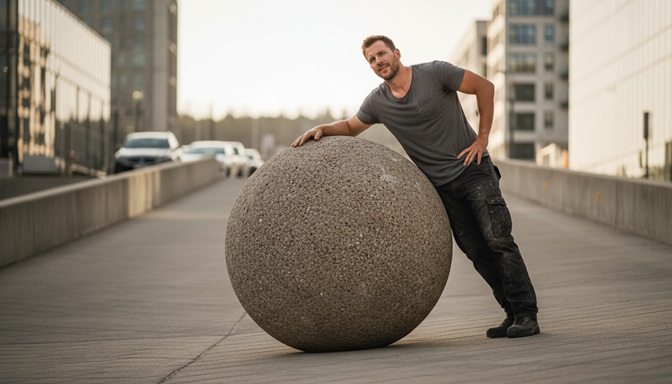
So if today you feel like you're pushing a rock, if you feel like every day is the same, if you feel like nothing changes no matter how hard you try... breathe. Go down the mountain in silence. Look at your rock. And decide. Decide that tomorrow you will push it again, but this time, your way. At your pace. With your meaning.
Because as Camus said: 'The struggle itself toward the heights is enough to fill a man's heart.' And filling the heart doesn't require the rock to reach the top. It only requires that you keep pushing, conscious, free, and with a less noisy heart.