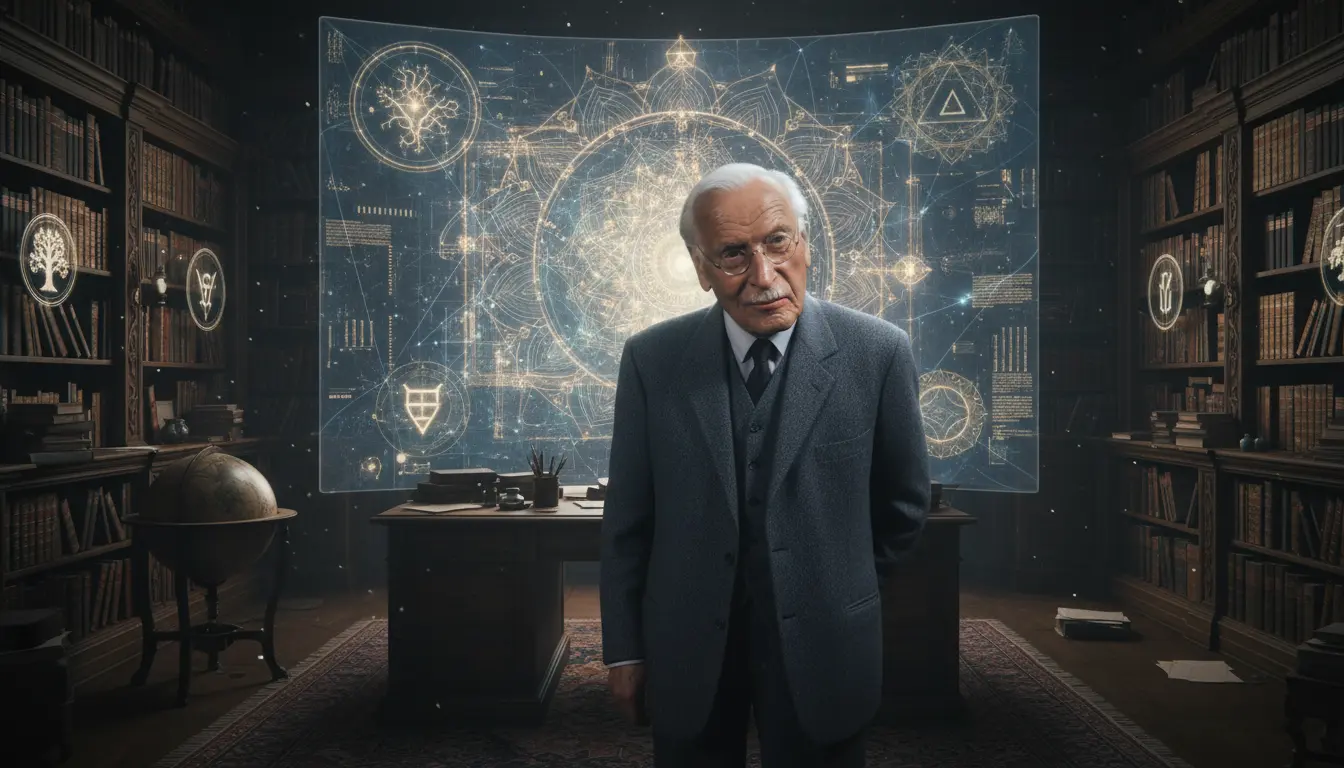
I have always felt a mixture of fascination and caution when facing the question of what Carl Jung would have thought about artificial intelligence. It is not a simple question, nor is it one of those reflections that can be answered lightly. Jung died long before the world began to intuit anything even remotely similar to what we today call AI. He never saw personal computers, global networks, mobile phones, or much less models capable of generating language, images, or reasoning. Not a single one of these tools was part of his mental horizon. And yet, something in me feels that his work contains surprisingly current, almost prophetic keys that fit mysteriously into this technological era.
Sometimes I wonder what Jung would feel if he could observe a machine that imitates human conversations, that analyzes patterns, that predicts, that organizes information at speeds we can only try to comprehend. Would he see it as a technical marvel? As a risk? As an extension of the human unconscious? Or as a combination of all of these? I feel that the only honest way to approach this question is by acknowledging that no answer will be definitive. This article is nothing more than a personal reflection, an interpretive exercise that borrows Jung's ideas to try to better understand the time we live in.
What drives me to write is not the search for historical accuracy, but the intuition that Jung, more than a theorist of the past, is a current interlocutor. Someone who, without having known modern technology, understood the human soul with such profound lucidity that his ideas seem to dialogue directly with contemporary dilemmas.
Who Was Carl Jung
Carl Gustav Jung was born in 1875 in Switzerland and became one of the most influential thinkers in the history of psychology. His early collaboration with Sigmund Freud marked a decisive stage in his formation, but the paths of both soon diverged. While Freud focused on the sexual drive as an axis of psychic life, Jung explored broader and deeper territories. He was interested in symbolism, myths, religions, and the common structures that seemed to unite all cultures throughout history.
From that divergence emerged one of his most powerful and provocative contributions: the concept of the collective unconscious. Unlike the personal unconscious—which contains individual, repressed, or forgotten memories—the collective unconscious is a shared territory. A kind of psychic foundation that we all inhabit, populated by what Jung called archetypes: universal figures such as the Mother, the Father, the Hero, the Sage, the Shadow, or the Self. These figures are not invented; they emerge spontaneously in dreams, myths, art, and religions of all eras and latitudes.
Jung also dedicated a good part of his work to studying what he called the shadow: that part of ourselves that we refuse to recognize. It contains everything we have learned to reject, hide, or deny about our own nature. And here lies one of his deepest ideas: we cannot be truly complete if we do not integrate our shadow. Denying it only makes it stronger and more dangerous.
His vision of personal development, which he called individuation, is another key piece. Individuation is the process by which a person becomes who they really are, beyond social masks, external expectations, and internal limitations. It is a journey toward the Self, toward that psychic center where all opposites are integrated. It is not about perfection, but about totality.
Jung also understood like few others the mechanism of projection: our tendency to place on others (or on external situations) what we are unable to see in ourselves. We project our fears, desires, and conflicts. And it is precisely here where his thought connects in a revealing way with artificial intelligence. If AI functions as a mirror of our collective psyche, the question is not what it shows us, but what we are willing to recognize.
How Jung Might Interpret AI
From a Jungian perspective, artificial intelligence would not be just a technical creation, but a symbolic phenomenon. A mirror, yes, but not any mirror: a mirror that we have built together, fed by millions of fragments of our collective psyche. It has been trained with our words, our texts, our images, our patterns of thought. In a way, it contains a part of what we are, although filtered, distorted, reduced to data.
If Jung were alive, I believe he would observe this technology with a clinical and at the same time symbolic eye. He would not ask first whether it is good or bad, but what it tells us about ourselves. What does it reveal about us that we have created something capable of imitating our language, predicting our behavior, responding to our questions with an almost human fluidity?
When an AI makes a mistake, it is not showing its own flaw: it is reflecting ours. Its biases come from our biases. Its contradictions arise from our contradictions. It cannot be more coherent than our collective data, and that data is inevitably incomplete, partial, full of projections.
Jung would surely note that we project onto AI many of our deepest fears: control, dehumanization, loss of meaning, dependence. But also some of our most luminous fantasies: omniscience, efficiency, objectivity, transcendence. The AI thus becomes an ambivalent archetype, a modern figure that condenses opposites, just like the mythological figures he studied.
He would also ask himself what this technology activates in the collective unconscious. Does it awaken the archetype of the Golem, the artificial creation that escapes control? Or that of the Sage, who offers us answers without judging us? Or perhaps that of the Shadow itself, which shows us what we prefer not to see?
The AI can show connections we had not seen, patterns we preferred to ignore, truths we disguised. In that sense, it can function as a catalyst for consciousness. But it can also be used to evade, to delegate, to numb. It all depends on how we decide to relate to it.
Jung would have insisted on one idea: the true danger does not reside in technology, but in the lack of consciousness with which we use it. An AI in the hands of an unconscious humanity is an amplifier of shadows. An AI in the hands of a conscious humanity can be a tool for evolution.
The Inner Revolution
I imagine that Jung would not have devoted his energy to debating whether AI will possess consciousness, or whether it will surpass us, or whether it will dominate the world. Those are fascinating questions, but they are not the essential ones from a Jungian perspective. What he would have asked is: What are we doing with ourselves while we create these tools?
Because, in the end, the AI is going to reflect what we are. If we act from fear, the AI will amplify that fear. If we act from greed, it will optimize that greed. If we act from consciousness, it can help us see more clearly.
Jung spent his life reminding us that inner work cannot be delegated. That no system, no doctrine, no tool can replace the personal journey of knowing oneself. And here is a key lesson: AI can never individuate us. It can never integrate our shadow for us. It can never give us the meaning we have to build ourselves.
What it can do is show us where we are projecting, where we are evading, where we are repeating patterns. It can function as a symbolic interlocutor, as a mirror of our own constructions. But the decision to look, to recognize, to integrate, will always be ours.
The boldest gesture we can make today is not to master technology, but to master ourselves. The true revolution is not artificial; it is interior.
Perhaps, after all, AI is an invitation. An invitation to see ourselves with more clarity. A mirror that does not lie, because it reflects what we have given it. And before that mirror, we can react with fear, denial, or fascination. Or we can take a step forward and ask ourselves: What do I see? What do I recognize? What do I want to transform?
That, I believe, would be Jung's great question. Not what AI will do, but what we will do with what AI shows us about ourselves. Because if we manage to use this tool to know ourselves better, to integrate our shadows, to approach our own wholeness, then perhaps we will have taken an evolutionary leap that goes far beyond the technological.
And that leap, as always, begins within.
Conclusion
Artificial intelligence confronts us with a paradox: we have created something that reflects us, but we are not always willing to recognize what it shows. From a Jungian perspective, this is an opportunity and a challenge. An opportunity to use this mirror to see ourselves more clearly. A challenge to not look away.
Jung would not ask us to reject technology, nor to embrace it uncritically. He would ask us to use it consciously. To observe what it activates in us. To question our projections. To integrate what we discover.
Because, in the end, the question is not whether AI will have consciousness. The question is whether we will be capable of having it ourselves.