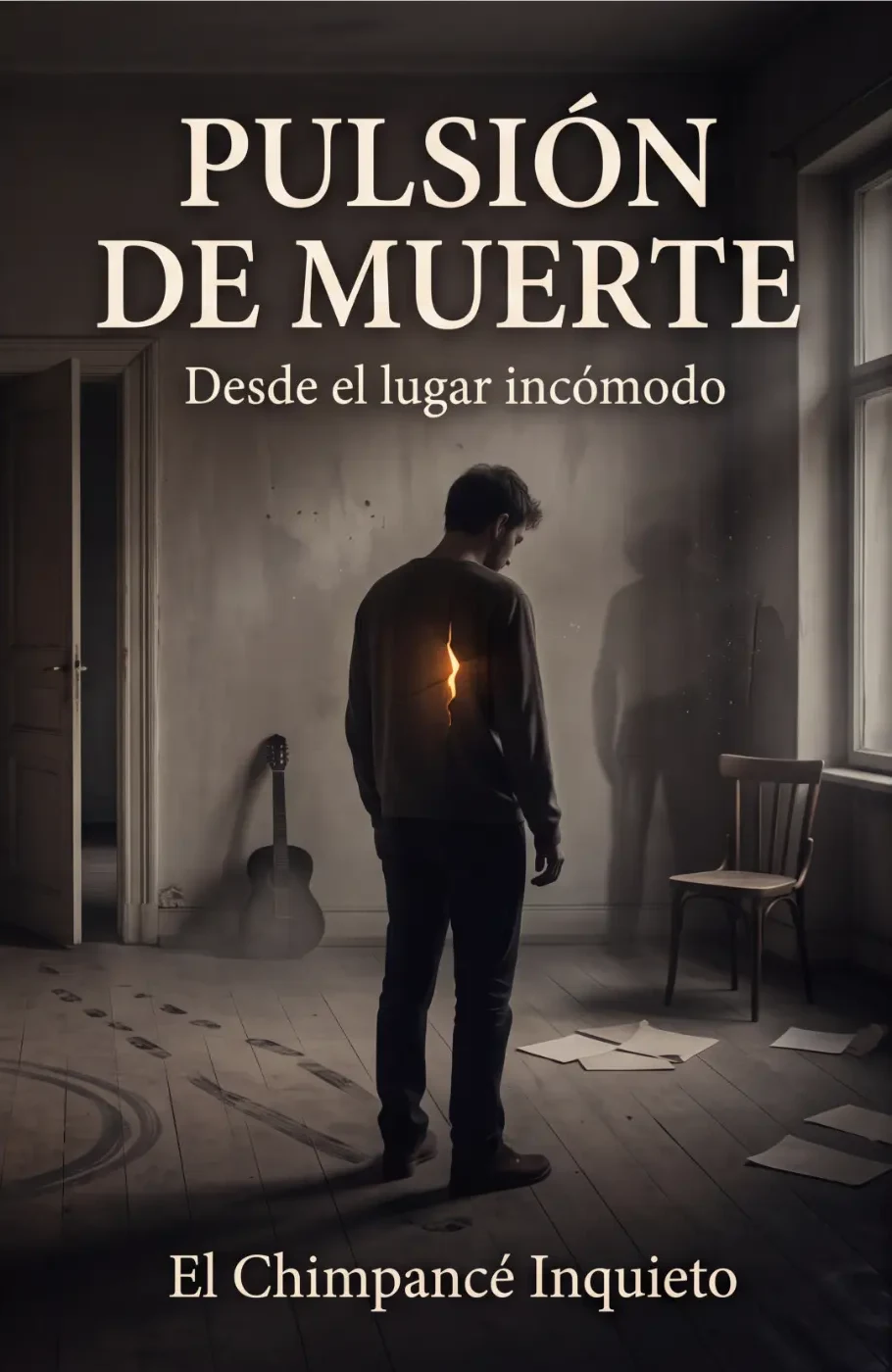
Pulsión de Muerte
Desde el lugar incómodo (From the uncomfortable place)
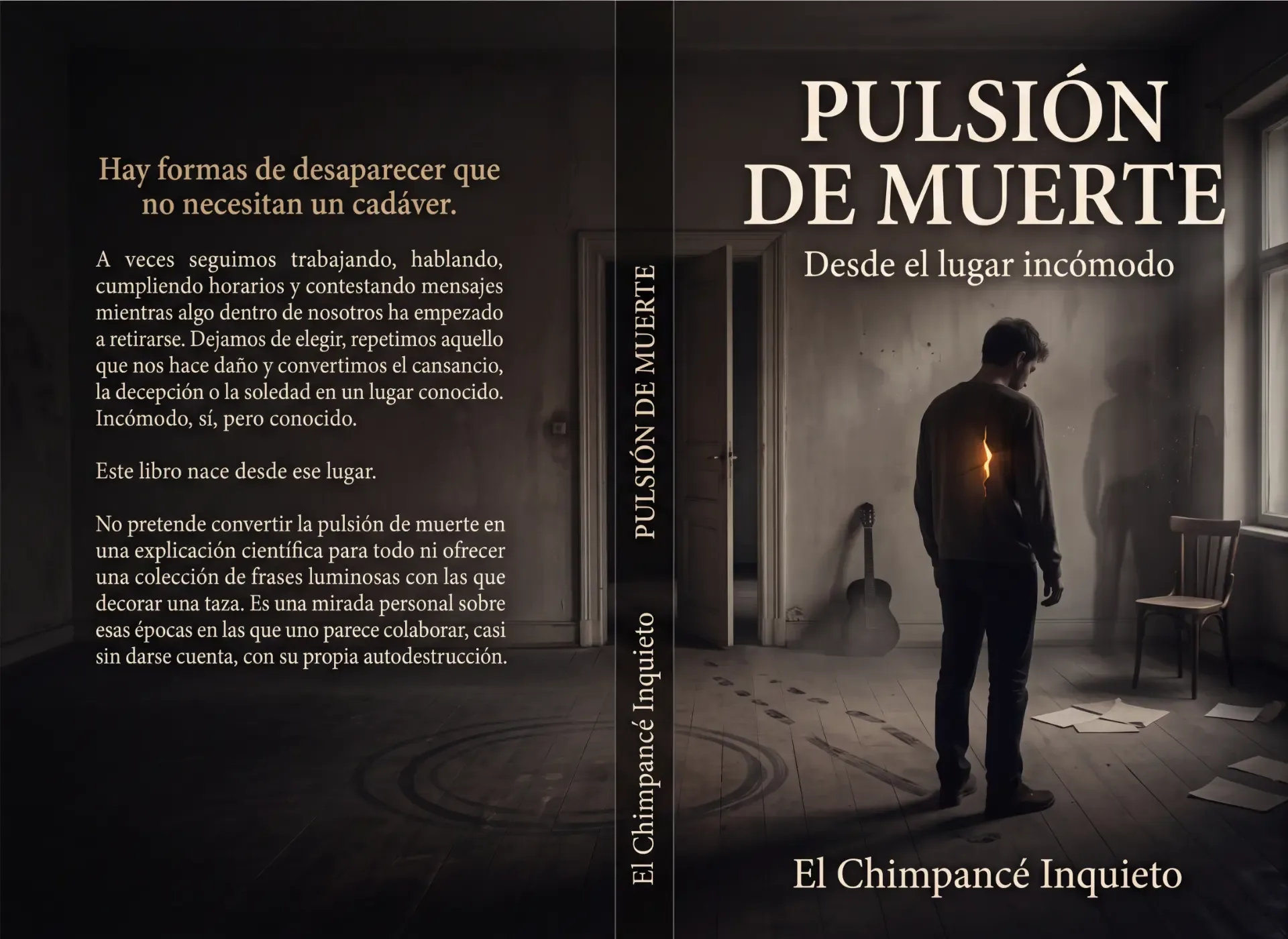
There are ways of disappearing that need no corpse.
Book details
- Author
- Jose María Ato Abellán
- Format
- Free PDF and printed edition
- Language
- Spanish
- Length
- 20 chapters, prologue and epilogue
- Subject
- Essay · Psychology
- Published
- 2026
6
parts
20
chapters
+
prologue and epilogue
What this book is about
Sometimes we keep working, talking, keeping schedules and answering messages while something inside us has already started to withdraw. We stop choosing, we repeat what hurts us, and we turn exhaustion, disappointment or loneliness into a familiar place. Uncomfortable, yes, but familiar.
This book is written from that place.
It does not try to turn the death drive into a scientific explanation for everything, nor to offer a collection of bright quotes to print on a mug. It is a personal look at those periods in which one seems to collaborate, almost without noticing, with one's own self-destruction.
An essay written from the inside
"Death drive" is an expression Freud put into circulation in 1920 which, read for the first time, seems to point to a secret urge to end one's life. That is not quite what it means. This book starts from that confusion to talk about something far more everyday: our strange ability to repeat behaviours that damage us, to fix destructive thoughts in our minds and to return again and again to inner places we claim we want to leave.
The journey does not begin in theory but in a personal crisis. From the wear of working with people to the refuge of solitude; from the scale that pain tilts until we forget those who are still there, to the moment when suffering stops being an episode and starts working as an identity. Only then do Sabina Spielrein, Freud and those who came after arrive to name an old suspicion.
It is not a self-help book nor a clinical manual. It promises no recipes, diagnoses nothing and replaces no professional. It is an honest essay, written with humour where humour fits, that dares to describe the uncomfortable place without decorating it and to ask, in the end, whether one can leave it.
Structure of the book
Prologue, six parts, twenty chapters and epilogue.
- 01
Part one. When something starts to fade
A crisis I still cannot name, life losing part of its colour, and the refuge of solitude.
- 02
Part two. The wear of other people
Working with people, education as a form of humanity, the scale of the human condition and the weight of unexpected disappointments.
- 03
Part three. An old suspicion
Before Freud: Sabina Spielrein. Freud and the death drive. Why we repeat what hurts us. After Freud.
- 04
Part four. The death drive in everyday life
Not wanting to die but ceasing to want to live the same way, suffering turned into identity, and a society that cannot stop either.
- 05
Part five. Looking at the other side of the scale
Those who are still there, the injustice of a scale distorted by pain, and why understanding is not the same as justifying.
- 06
Part six. Choosing, even without knowing how
Can one leave this place? A different way of being alone. Facing the death drive. Epilogue: what remains after writing.
Who this book is for
- For anyone repeating what they know is hurting them.
- For anyone who has turned tiredness or disappointment into a familiar place.
- For anyone who wants to understand the death drive without clinical jargon.
Who it is not for
- For anyone looking for quick fixes or self-help slogans.
- For anyone expecting a clinical manual or a diagnosis.
- For anyone in urgent need of help: that calls for a professional.
From inside the book
You start looking for an explanation and, before you know it, you have opened a Word document and written tens of thousands of words trying to work out what is happening to you.
Conformism wears very convincing disguises. It can be called prudence, responsibility, realism, patience or simply tiredness.
Things are still there — work, family, projects — but they lose part of their power to summon us. Talking is tiring. Deciding weighs.
Important note
This book is a personal essay, not a clinical text. It does not replace diagnosis or treatment by a mental health professional. If you are going through a hard time, ask for help: in Spain you can call 024, the suicide prevention helpline, available 24 hours.
Get the book today
You can download the full PDF for free now, or wait for the Kindle and paperback editions on Amazon.