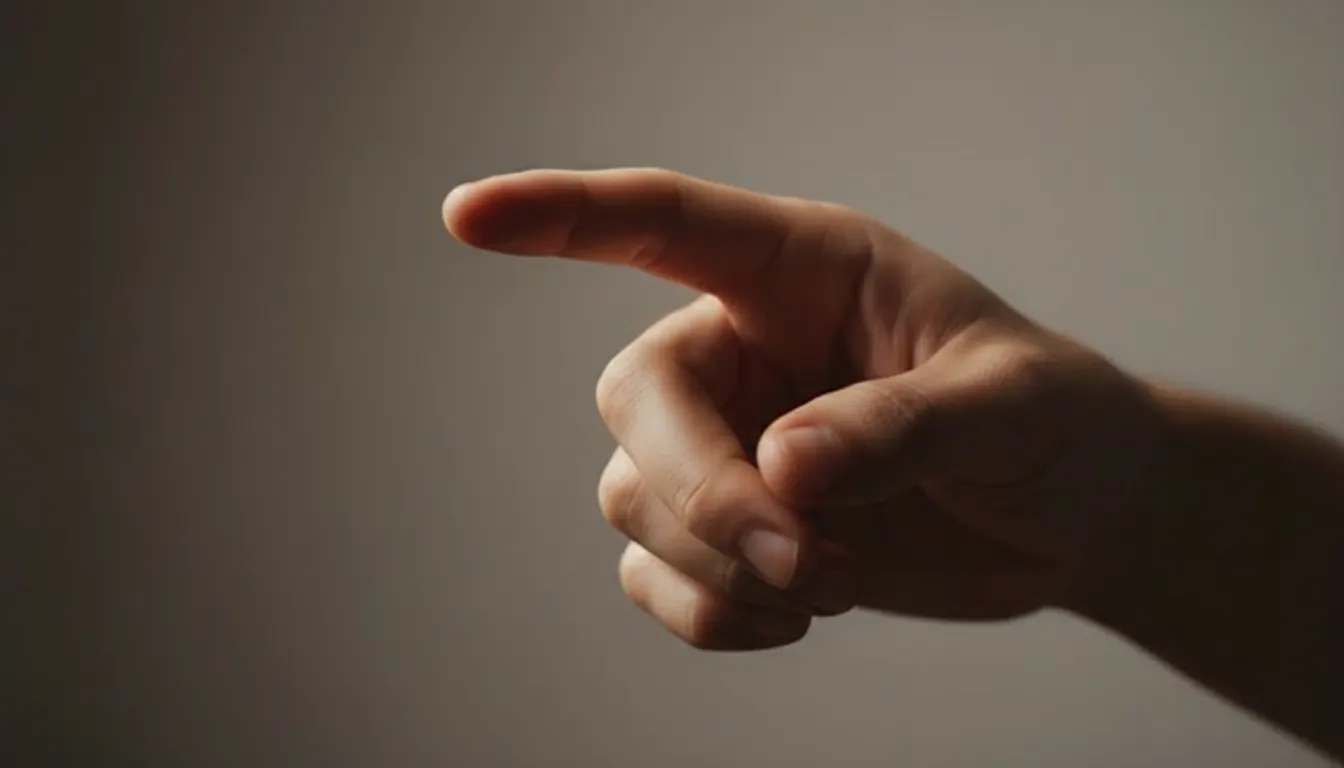
Opening: the instant the finger shoots out
There's a second, barely a heartbeat, when the index finger shoots forward as if it knew more than we do. It's an ancient gesture, almost a reflex: we point. We point at the driver who cuts in line, at the colleague who arrives late, at the algorithm that "doesn't like us." We point because it hurts and because it relieves. And yet, in that very same second, three fingers fold back discreetly toward the palm, pointing at us with a sobriety that makes no noise. The proverb says it without flourish: when you accuse outward, three reminders remain inward. My approach is based on this awareness of our responses.
If you pay attention, the gesture has its own music. It's the small snap of an idea that believes itself a sentence, the whip of an arching eyebrow, the air that escapes through the nose before the first harsh word. It happens at a crosswalk, with the light turning amber and a car pressing forward. It happens in front of the inbox, when an unanswered matter feels like disrespect. It happens with a notification that touches a pride we didn't even know we carried. The finger, like a veteran actor, knows its stage mark by heart: it goes out without asking us if the script is good.
What's curious is that, if you pause the scene, there's another simultaneous story. While the index finger stretches outward, three fingers fold inward and point to a territory not seen in the picture: the internal climate with which you arrive, the small decisions that brought you to this point, the possibility of a different gesture right now. That folding is silent, almost tactile. Sometimes it feels like barely a touch on the skin: a brief discomfort, a shy awareness that something of this is also ours.
The day offers a thousand occasions for this micro-drama. On the screen, at the office, in the kitchen. In the elevator with the neighbor who doesn't greet. In the hallway when the project goes wrong and nobody wants to name it. At the traffic light when another doesn't understand your hurry. Sometimes with words that cut; other times, with a clenched jaw and an eye that won't look. Always with that false promise of immediate relief: if I point, I free myself. But the relief the finger offers is like drinking saltwater: it calms for a second and leaves more thirst.
And then the proposal arrives, humble and demanding at once: every time the gesture is born, you can spend your energy chasing culprits or you can invest it in reclaiming the helm. It's not a moral slogan, it's a vital design choice. A way to place attention so the day doesn't live you. You can build a stairway to grievance—word upon word, screenshot upon screenshot—or you can step down from the stool and turn the wheel of your life a quarter turn. One of those movements is noticed immediately but empties you; the other takes a while but brings you home.
From here forward, this article is a practical essay on that turn. It doesn't compete with your instinct—which is human and legitimate—it accompanies it and offers a map. Because pointing at the world is a daily temptation, but returning to yourself, ordering, breathing, and speaking better is an art that requires training.

The gesture and its shadow
Pointing is a fast-acting painkiller. It enters like a flash and orders the story in three sentences: I'm fine, someone did wrong, matter resolved. That simple narrative offers immediate relief and a borrowed sense of control. But it's cardboard control. It gives a fictitious order to avoid looking at the real disorder: the one living inside. Like every painkiller, it comes with fine print. With frequent use, it numbs the finest muscle we possess: responsibility. I'm not talking about guilt—that useless stone that only sinks—but about the maturity that returns agency and room to maneuver, the faculty to adjust course even when the sea doesn't help.
The gesture becomes habit when we confuse discharge with solution. Each pointing grants a small narrative victory: I'm right, the world is wrong. But by the fourth or fifth time, the victory transforms into a role. Without realizing it, we move from solving to collecting grievances; from conversing to pontificating; from asking to passing judgment. Curiosity, which is the breathing of bonds, goes into apnea. Social life—at home, at work, on the screen—becomes an accounting of others' faults.
Sometimes the accusing finger is born from brute exhaustion: sleeping little makes the world coarser and our neighbor less forgivable. Other times, it emerges from fear of being discovered fragile: if I point quickly, no one will see I'm trembling. In seasons of noise, we use it as a pass of belonging: I point to prove I'm on the correct side, to not be left outside the circle that murmurs. The platforms, which have industrialized indignation, do the rest: one touch, one spark, a hundred brief applauses. The gesture is rewarded and replicated. And yet, when the volume drops, something in us knows that joy is syrupy: sweet and short.
The body also participates in this theater. With sleep, hunger, and haste, the index finger takes off before the mind can think. We call "character" what, many times, is unattended physiology. Two glasses of water, ten deep breaths, a decent snack are enough for what we saw as an offense to suddenly appear as a misunderstanding on the way to repair. It's not magic; it's basic chemistry in favor of peace.
The cost of constant pointing is not only moral, it's operational. Every time I throw responsibility outside, I become a little more a spectator of my own life. I delegate power to what I criticize. I lose levers. And I open a checking account of toxic interest: resentment that accumulates, conversations that rot for lack of air, decisions that others end up making for me. That victory that seemed cheap is paid, in the end, with solitude and clumsiness.
Stopping pointing isn't swallowing your voice or making complicit silence. It's speaking from another place. It's choosing a tone that doesn't humiliate, a precision that doesn't ignite, a firmness that cares. When that happens, the gesture changes nature: the finger stops being a weapon and becomes a compass. And that small turn inaugurates a different landscape: I no longer need to be right all the time; I need to understand better and act better.
That's why, when the volume drops and I listen honestly, I recognize what I already intuited: the victory of pointing is small and expensive. It comes to us in installments, with high interest. I prefer to pay cash with another currency: that of responsibility that returns margin today and peace tomorrow.
The three fingers that return home
The wisdom of the proverb is not in scolding us, but in offering us a map that begins in the palm and ends in the voice. If three fingers point at me, perhaps each one brings a different and complementary message; not a judgment, but three invitations. The proverb doesn't demand sainthood: it suggests direction. And the direction, almost always, is back home: to the body, to the decisions, and to the next gesture.
The first one asks me about my internal state, with the kind impertinence of someone who knows you closely. How do I arrive at this conversation? Did I sleep enough or am I carrying two coffees as armor? Did I eat something decent or have I negotiated with hunger to run a little more? Am I in race mode, with my jaw clenched, or is there air between thoughts so a serene idea can fit? What this finger remembers is elemental: there's no spirituality or technology that can fix a dysregulated body. An algorithm can amplify your voice, but it can't lower your pulse. An AI tool can order your agenda, but it can't exhale for you. Sometimes the conflict isn't philosophical: it's physiological. The tone rises because blood sugar drops; judgment narrows because breathing is shallow. The paradox is that we know this and yet we struggle to grant ourselves the basics: drinking water as an intelligent gesture, breathing deeply as a precision technique, slowing the pace like someone recalibrating an instrument. That grandmother's advice—sleep, eat, move, breathe—is human engineering. When the body returns to a habitable range, the world stops seeming like a permanent threat. Then the finger, which was already heading hard outward, loses urgency. You discover you didn't want sentences: you wanted rest.
The second finger reminds me of the small decisions that brought me here, those that don't appear in the epic and yet sustain—or sabotage—the plot. It dismantles the comfortable narrative of "they did this to me" and, at the same time, liberates: if I participated in building this labyrinth, I can participate in opening it. There were almost always signals I chose to ignore, emails I left for the Monday that never came, conversations postponed out of fear of discomfort, boundaries I didn't set because I preferred to be nice rather than clear. The heroic biographies we tell ourselves hide prosaic details: a "I'll look at it tomorrow" that lasted three months, a "it's understood" that was never understood, a "it's not that big a deal" that ended up being a fire. Looking there isn't self-flagellation; it's recovering levers. It's not about inventing new culprits, but doing archaeology of the process: when did the rope twist?, what silence planted the misunderstanding?, what promise did I make without a calendar? Responsibility, seen this way, isn't a burden but a toolkit: naming the unspoken, adding dates to the ambiguous, converting expectations into agreements, changing diffuse courtesy for precise kindness. You don't do it to carry everything, but to stop depending on chance. There's a sober dignity in recognizing: "here I avoided looking." That recognition creates light where before there were only long shadows.
The third one questions me about the now with a mixture of urgency and delicacy. What can I do in this very minute that improves the matter a little? Not the perfect plan that transforms me into a legend, but that discreet movement that reduces the problem by one percent. Perfectionism wants epic; life appreciates precision. A clear message with a single concrete question. A proposed date instead of a "we'll see." A brief call to deactivate a novel that only exists in my head. A "this doesn't fit me" said in time before resentment rusts in silence. This third finger doesn't ask for grandiloquence; it asks for focus. It remembers that robust solutions are woven with small repeated gestures, like someone putting a door back on its hinge and checking, with relief, that it stops banging in the wind. Sometimes the best strategy is ten words and an open calendar. Other times, a clean "no" that frees two people.
When one listens to these three fingers with patience, something curious happens: the accusing finger—the one seeking discharge—loses appeal. Not because the outside is always right, but because looking inside reveals a portion of freedom that can't be achieved by pointing. Internal state is cared for, decisions are illuminated, minimal action is executed. And then, even if the other party is wrong, you no longer need theater. You can speak with firmness without ferocity, request changes without dramatizing grievances, negotiate without sacrificing peace. That's the map the proverb offers without shouting: return home, tidy yourself up a bit and, from there, go out to fix the world.
It's enough to rehearse this sequence in a concrete scene to understand it in everything else. On social media, for example, when a criticism brushes your skin and your blood boils, the first finger asks you if you slept poorly today or if you've lived on screenshots and coffee; the second reminds you that you posted without reviewing because you were in a hurry and that perhaps you promised an impossible frequency; the third invites you to write three lines to clarify or to quietly withdraw what doesn't represent what you want to say. None of this is spectacular, but it creates a new groove. Over time, the gesture becomes reflex: before pointing, you return to yourself. And from there you choose better.
What seemed like a moral slogan turns out to be an operational procedure: body that breathes, history that assumes its part, movement that unclogs. Three fingers that return home so that, if pointing is necessary, it's to orient and not to condemn.
The meter rule
Imagine your life had a wooden ruler with a mark one meter from the tip. Everything that falls within that meter is your immediate jurisdiction. What remains beyond, however important it may be, doesn't admit your hand now. On noisy days, when your fingers demand trenches, measure again: what is within a meter of me that I can improve? Do that. Then, we'll see.
That meter isn't a resignation, it's a focalization. It's the distance where your word still has specific weight, where your fingers—the three that return home—can transform air into matter: the breath that regulates the voice, the phrase that prevents a fire, the call that unclogs a week. Beyond that radius desires and conjectures stretch; inside, the hand touches wood.
In construction we understand it well: with a meter, a plumb line, and a level you correct a wall; with speeches about the world's humidity nothing straightens. Life, like a partition slightly out of square, sometimes only needs someone to measure again and adjust two millimeters. It's not epic, but it's the difference between a door that rubs and one that opens smoothly.
The meter also serves to protect you from others' storms. When a loaded message arrives, the act of measuring returns sovereignty to you: within the meter are your tone, your clarity, your limits; outside are the other's history, their day, their fatigue. If you try to reorder what's beyond before ordering what you carry inside, you enter a choreography you don't direct. You measure, breathe, respond. Sometimes, you even decide not to respond yet: postponing is also a form of precision.
In the digital realm, this criterion cuts noise like a clean knife. Within the meter are the script you choose, the time you dedicate to thinking before publishing, the editing that separates impulse from message, the choice of words that don't give away your attention to controversy. Outside are the trend curves, the changing algorithms, the opinion of those who were never there when it was time to build. If you attend first to what's inside, what's outside loses pulling power.
The meter doesn't reduce to the ergonomics of gesture; it includes the calendar. Within a meter is today and, with luck, a bit of tomorrow. If you promise a month ahead from this afternoon's anxiety, you distance yourself from your tool. The meter reminds you that coherence isn't decreed from afar; it's manufactured close, with humble constancy: today I do what I said I would do today. Tomorrow, tomorrow.
It also serves to ask for help. Sometimes the bravest thing within the meter is to admit you can't reach, that you need another hand. Honesty is another measurement tool: it delimits where you end and where the other can begin without invading or being invaded. When the perimeter is clear, the team appears.
A workshop trick: when everything seems urgent, place the ruler on the table and name quietly three objects already within your reach—the water glass, the phone, the agenda—and perform a gesture on each. Drink. Call. Note down. Not to cross off tasks like shooting, but to recover your pulse. After that minimal triangle, the world returns to its real size.
And if you doubt, return to the smallest possible scene. The meter teaches you to start with the tile you're standing on. A less sharp word. A longer silence. A better formulated question. A commitment you can honor today. The rest, however much you care about it, will have its turn when your arm reaches. Because that's the method's promise: when you care for your meter, your meter expands.
Technology, attention, and that old desire to be right
On social media, reaction is rewarded; in life, response is. That asymmetry creates a lag we feel in the body: the thumb wants speed, but consciousness needs space. Platforms convert the public square into a button: an infinite stage to point with a single press. The finger travels faster than reflection and offers a tiny, addictive reward: the discharge of belonging, the brief applause, the illusion of being on the right side. It lasts as long as a spark lasts. To sustain real warmth requires other fuels: attention, patience, and an honesty that asks without fear why that comment hurt me so much, or why I expected the algorithm to give me what I haven't yet cultivated: constancy, clarity, community.
The temptation to be right is ancient; technology only accelerated it. The keyboard loves certainties because they don't sweat. But life, which is more skillful than our speeches, usually rewards those who dare to delay: those who allow themselves a night in between, those who reread coldly, those who commit the audacity of asking before concluding. Speed shines; delay enriches. Between both, our spirit chooses whether it wants flashes or warmth.
Taming the tool is, at bottom, taming the finger. It's not about renouncing the digital, but building railings for attention. The first is invisible and simple: a reminder that appears before publishing hot, as if a friend touched your shoulder and told you "breathe." The second is a small ritual—three counted breaths, reading aloud, leaving the draft open and walking for a minute—that interrupts the impulse just enough for intention to sit back in the chair. The third is calendar: separating creation from publication so the night edits vanity and precision gains ground.
There's also a soft engineering we can practice daily. Writing first in a notebook that publishes nothing, a vent without an audience where emotion has permission to pass. After that first wash, opening the "real" document and seeking the clean phrase that still wants to be said. Converting judgments into observations, generalizations into data, easy irony into difficult clarity. Technology is capable of amplifying any of those versions; it's up to us to choose what to amplify.
AI, if placed on the side of lucidity, is not a megaphone for haste but a mirror for tone. You can ask it to return the text "with serene firmness," to point out ambiguities that could be misinterpreted, to propose a version that cares for the relationship above victory, to reduce the central purpose of the message to one sentence. Not to obey it blindly, but to hear a second reading when the ego is in loudspeaker mode. Used this way, AI won't supplant your judgment: it illuminates it.
The old desire to be right usually hides fear: fear of losing status, of being ignored, of the other not recognizing us. The network makes an industry of that fear: it quantifies it in views, measures it in comments, covets it in peaks of attention. If you don't build your own defenses, you end up asking the machine to confirm every day that you exist. And when it doesn't, you point. A perfect circle for frustration. The way out isn't to turn everything off, but to choose the moments and modes. Publishing from the center instead of from the edge.
There are small tactics that return command without turning life into a protocol. Try it like this: every time a notification upsets you, pass the text through your breathing. Read it quietly and observe if your body becomes rigid. If it does, let the message wait until the next round hour. If it still stings, translate it to its strictly informative version and ask yourself if it would still be necessary that way. Half the fires go out by removing adjectives. The other half go out by converting them into questions.
It also helps to distinguish two clocks: the algorithm's and the bond's. The first values peaks and mechanical constancy; the second honors shared memory and reliable word. When you write for the clock of bonds, you breathe differently. You name carefully. You renounce the killer phrase if it sacrifices trust. That renunciation, paradoxically, creates a more resistant community: less noise, more root.
Don't confuse silence with submission. Sometimes the most forceful gesture is to wait. Other times, to write privately what publicly would only make theater. Other times, to say "no" with a courtesy that doesn't negotiate. Technology isn't at odds with these nuances; it only requires you to decide which pattern you obey. If you obey the fury meter, you'll harvest vertigo. If you obey the care of the bond, you'll gather a discreet peace that lasts longer than any audience peak.
The day you discover yourself about to "prove" something, try an alternative: tell what you learned. Demonstration feeds the ego; learning feeds the relationship. And in the long run, it's relationships—not rhetorical swipes—that sustain work and life.
When you adjust these levers, the finger stops being a trigger and becomes an instrument again. You publish with less anxiety, respond with less gunpowder, choose your battles with more judgment. You don't become perfect; you become freer. And that freedom, which seems small on the timeline, is enormous inside: it allows you to go to bed without the buzz of someone who confuses any noise with music.
A domestic scene
You come home in a hurry. Someone left the kitchen messy. The finger tenses. You have a speech prepared for days, with statistics, grievances, and sentences. You know it by heart. But you surprise yourself drinking a glass of water and leaning your back against the counter. You enter the scene through the least heroic door: "I'm tired and seeing this put me in a bad mood. Shall we solve it together and tomorrow we'll talk about how to organize it?" You didn't win the argument, you won the home.
A work scene
The delivery is delayed. Your name is on the cover. Notifications make the background chorus. You start drafting a harsh message. You delete it. You call: "I need to know what part got stuck and what you need from me to unstick it. This afternoon I can dedicate half an hour to help you. Tomorrow we'll define the process so it doesn't happen again." No one will give you a medal for that phrase, but when you close the day, the project advances half a meter. Sometimes elegance consists of moving half a meter today, and half tomorrow, and half the day after.
A practice that fits in your pocket
When you notice the index finger is already in flight, try a brief anchor. Stop for a moment. Inhale counting to four. Hold the air for an instant, exhale longer than your hurry inspires. Repeat twice. Write yourself an honest line: "This hurts because of X." Add another: "What is in my hand now is Y." Do Y, even if it's only the first brick.
Not because you're a saint. Because it works.
When the other person really is wrong
Taking responsibility doesn't mean swallowing toads. Neither is it distributing blame by shouting. There are occasions—and they're not few—when it's appropriate to speak clearly and draw a sharp boundary. The difference lies in the spirit with which you do it: not to humiliate or collect victories, but to care for common ground and, incidentally, care for yourself. A timely no saves storms. An explicit limit avoids the factory of misunderstandings. And if your voice trembles, let it tremble: dignity also trembles when it's born.
First, the pause. When the other really makes a mistake, the body asks for reaction; the finger arms itself. That's where breathing isn't decoration but tool. Two rounds are enough for blood to return to ears and tongue. The pause doesn't absolve the other or erase the harm; it only returns the helm to you so you don't drive with rage's headlights.
Then, the facts. Describing precisely what happened is harder than it seems because grievance wants poetry and agreement needs prose. "We agreed Tuesday at 10, it was 12 and you didn't come" is different from "you always fail me." The first phrase opens a door; the second raises a wall. When you name the fact without adornments, dialogue breathes.
Next, the impact. It's not about dramatizing, but putting light where it hurts. "That left me hanging with the client and cost me credibility" informs and places context. It doesn't accuse anyone's soul; it explains the consequence. First-person language is a discreet key: it doesn't judge the other's character, it shows the trace of the act.
Then, the request. A concrete correction has better fate than a diffuse complaint. "I need you to confirm attendance the day before or, if you don't arrive, notify me with an hour's margin" is a phrase that can be fulfilled or not, but can't be misinterpreted. When the request points to observable behaviors, the limit stops being an emotion and becomes a possible agreement.
And, finally, the agreement and its trace. "Does this fit you?" "What do you need from me for this to work?" "I'll leave it in writing in two lines and we'll review it Friday." The brief summary—a message, an email—isn't distrust: it's shared memory. On stormy days, that paragraph is a lighthouse.
Sometimes, even with all that, the other denies the evidence, displaces the conversation, or returns the blow. Here your calm isn't passivity; it's contained power. You can say: "I'm not going to argue about my perception. I'm telling you the effect this has on my work. If you prefer, we'll find someone neutral to help us sort this out." If respect breaks, the limit changes tone: "I can't continue this conversation like this. We'll resume it when we can do it well." It's not theatricality: it's hygiene of the bond.
There are harder cases: those who lie, those who manipulate, those who ridicule. You're not obliged to stay at that table. The meeting can be lifted. It can be escalated to a third party. It can be documented and a stage closed. Forgiveness, when it comes, let it be free; protection, let it be immediate. Compassion isn't at odds with firmness; on the contrary, it needs it to not become naivety.
In the digital realm, the temptation of mud is constant. Slander, sarcasm, deliberate misinterpretation. Responding right there, with high pulse, only fattens the spectacle. Sometimes the best truth is the sober one: a brief clarification in public and a conversation in private. Or strategic silence when the other party only seeks noise. It's not cowardice: it's energy management. Your word has more future in terrain where there's still listening.
There's also the uncomfortable mirror: the other was wrong, yes, and yet I added fuel. I did it out of pride or fatigue. Here taking responsibility doesn't mean diluting the other's fault, but assuming one's own fragment. Saying "I went too far in this" without demanding reciprocity is an expensive gesture, but it opens a space that the accounting of grievance never grants.
If the pattern repeats—you always reach the same point, with the same feeling of swallowing stones—you're no longer talking about an episode: you're talking about a system. And systems are changed with structural decisions. Reduce exposure, redefine agreements, redistribute loads, close cycles. Sometimes misunderstood loyalty ties us to dynamics that only respect our patience, not our dignity. Letting go can be the highest form of respect for both.
And yet, there are also times when the other, seeing themselves named with clarity and care, corrects. There it's wise not to climb any podium. It's enough to thank the gesture, adjust the process, and continue. Greatness, when authentic, makes no noise.
When the other is wrong, the three fingers keep pointing their route: care for internal state to not fight from chemistry; review what decisions of mine fed the misunderstanding; execute now a clean gesture that brings order. That triangle doesn't absolve the other, but it returns you to yourself. And from there, justice looks less like revenge and more like clarity that builds future.
Epilogue: three fingers, one direction
The proverb doesn't demand sainthood: it asks for honesty. It doesn't want to see you perfect; it prefers you awake. Every time the index finger shoots out like an arrow, remember the complete gesture: there are three fingers that return home and propose a more humble and more powerful movement to you. Come back in. Look at the room from inside: your pulse, your spirit, your small decisions, your margin right now. Daily greatness usually has this discreet form: a breath that lowers volume, a phrase that avoids harm, a "no" that cares.
If you ever get lost, rehearse the reverse of the gesture. Turn your hand. Let the index finger, instead of accusing, become a guide; let the three fingers that point at you become a reminder: first I order inside, then I speak outside. This turn doesn't subtract force from you; it returns precision. It's the difference between shooting at noise or lighting a light.
Life doesn't always change with great feats; often it straightens with centimeters. An adjusted hinge, a written agreement, an hour of sleep, a message sent with a regulated body. When you train that type of victory, the day stops seeming like a battle and becomes a workshop: you measure, correct, test, thank, and continue. It's not heroic, it's habitable.
There will be days when the world pushes you to race: notifications, urgencies, opinions that prick your skin. Precisely there the proverb becomes a tool. Before pressing "send," return to the three fingers: how am I?, what part was mine?, what clean gesture can I do now? If you choose from there, you may not win the afternoon's argument, but you'll win the night.
At first the change is almost invisible, like when a door finally fits and stops banging in the wind. Then, one day, you discover you no longer need to point so much because you've recovered the helm. And then you recognize the simplest and hardest lesson: dignity doesn't shout; it breathes.
Calm. Judgment. Action. In that order.