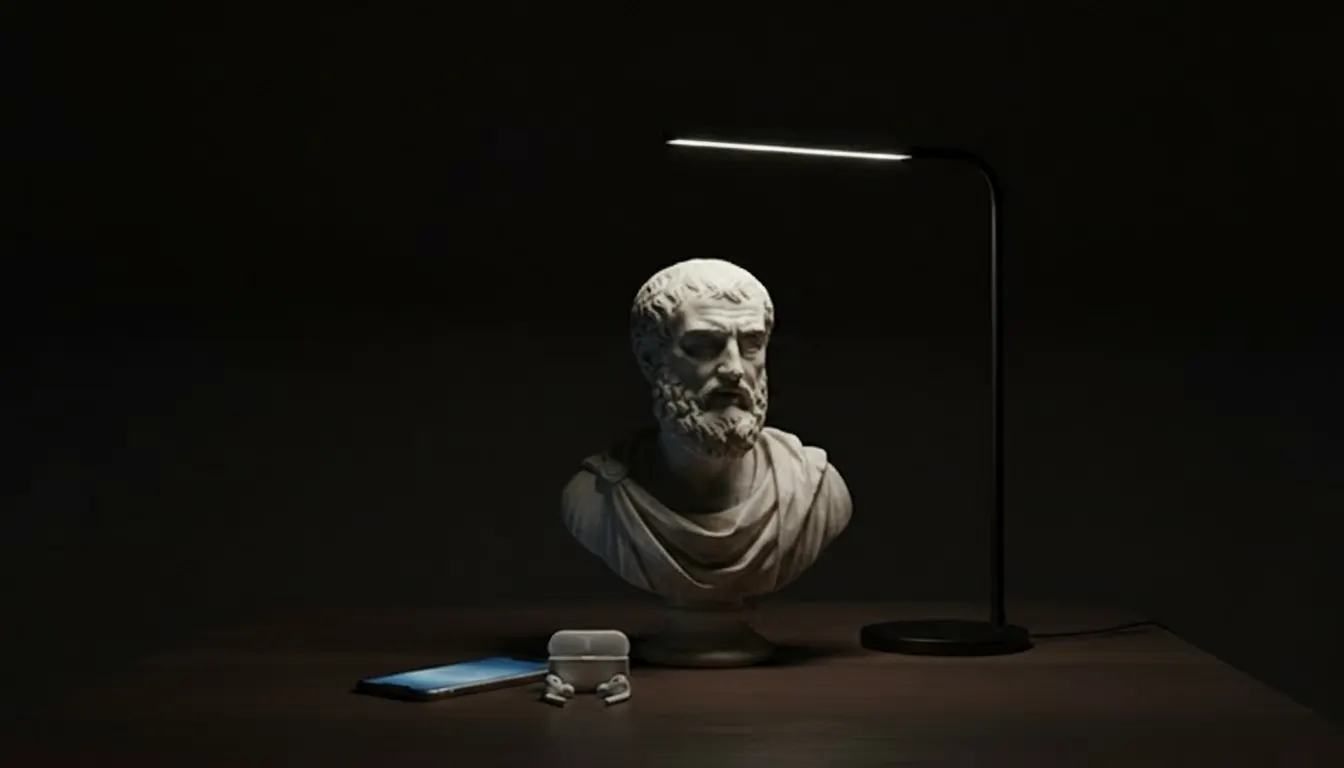
Where Stoicism comes from (and why it serves me today)
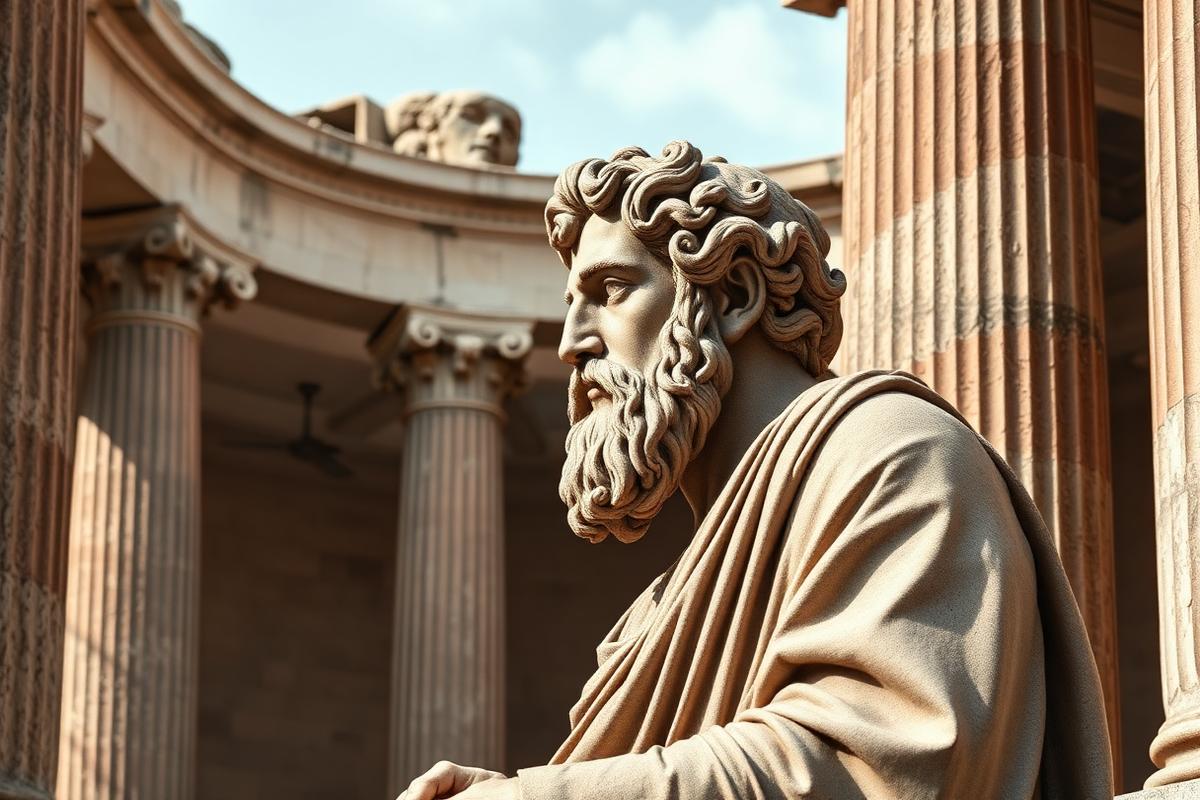
Stoicism was born in the porticoes of Athens with Zeno of Citium, yes, but it didn't spring from nothing. There's a story I like because it sounds like the beginning of a movie: Zeno, a Phoenician merchant, is shipwrecked and arrives in Athens with only the clothes on his back. He enters a bookstore, comes across a volume about Socrates, asks where one learns to live like that, and ends up as a disciple of Crates, a Cynic who taught by example and boldness. I don't know how much is legend, but it serves me: one doesn't always choose what happens; one can choose what to do with what happens.
Before that scene, the conversation had been going on for a long time. There's Socrates, with his habit of turning ethics into a daily exercise and not a tavern speech. There are Antisthenes and Diogenes, the Cynics, who defended a simple life and an almost insolent independence of judgment. Heraclitus resonates with his logos, that idea that there's an order in the world that doesn't bend to our whims. The Megarians contribute a taste for fine argument, and the Cyrenaics force refinement when they speak of pleasure. With all that, the Stoa is built on three floors: physics, logic, and ethics, like someone raising a house with structure, wiring, and life inside.
The early Stoa lays the foundations.
Cleanthes sings to the order of the cosmos like someone intoning a litany. Chrysippus, the great engineer of the system, fits logic with ethics and builds a method for thinking without cheating oneself. The middle Stoa, with Panaetius and Posidonius, opens windows and mixes with public life: politics, history, science of their time. Rome listens and adopts that tone. The late Stoa brings philosophy down to earth. Seneca writes letters to a friend about how not to waste life. Musonius Rufus teaches whoever wants to learn, slaves and aristocrats included, and talks about cooking and rest as philosophical matters. Epictetus turns his key distinction between what depends on us and what doesn't into a manual. Marcus Aurelius, between campaigns and offices, writes to himself to govern himself before governing anything. In that arc, the classical polis dissolves, the world becomes imperial and cosmopolitan, and people seek a way to stand when everything around changes. Sounds familiar.
When I dig a bit deeper into the workshop, strange words appear that, translated, become tools.
Oikeiosis is that movement by which I make my own what was initially foreign to me and expand my circle of care: from me to my people, from my people to my city, from my city to the world. Kathekon is what needs to be done here and now, even if it's not heroic or gets likes. Prohairesis is the core of rational choice that no one can take from me if I care for it. Sympatheia is that intuition that everything is connected and that my decisions have echoes I don't see. Pneuma is the vital tension that holds things in Stoic physics; I don't need to sign every metaphysical detail to keep the message: live connecting causes and effects, without magic, but with wonder. And I keep two jewels in my pocket: phantasiai, the impressions that arrive without asking permission, and sunkatathesis, the assent with which I decide whether to marry those impressions or not. There's a direct bridge to AI there.
Epicurus and I: less factional fighting, more life lived
There's another family with which Stoicism argues and, in its way, shakes hands: Epicureanism.
Sometimes they're painted as rivals, but I see bridges. Epicurus speaks of ataraxia, that tranquility that arises when you distinguish between natural and necessary desires—eating, resting, having shelter, having friends—and desires that are pure whim with emotional hangover. He proposes prudent pleasure: more bread and olives with friends than wild banquets; more walking in the sun than window shopping. His tetrapharmakos—don't fear the gods, don't worry about death, what's good is easy to obtain, what's bad is easy to endure—sounds very good in a world that confuses desire with necessity every five minutes. The Stoics, for their part, nail another idea: virtue as the only good; health, wealth, or reputation as preferable, yes, but not essential. I mix the two intuitions and get a sensible life plan: serenity inside, simplicity outside, pleasures that don't charge interest, a shared table, a garden—literal or figurative—and a serene commitment to acting well even if no one applauds.
I also like what Epicurus says about friendship as practical refuge. I'm not talking about a network of contacts for doing business: I'm talking about people with whom you can be yourself without disguise, eat simply, talk without posing. That's also happiness technology. And yes, his atomist physics isn't mine, but it serves its function: removing metaphysical fears that only add anxiety. I don't want philosophical faction wars; I want tools that work when the day goes wrong.
What I control and what I don't (and why I repeat it so much)
Seneca and Marcus Aurelius taught me to separate two boxes. In one goes what depends on me: my attention, my objectives, the data I choose to look at, how I formulate questions, the reviews I do, the decisions I sign with my name, my ethics, and the work cadence I impose on the day. In the other box lives what I don't control: the next version of a model, the fickle algorithm of a network, platform volatility, market mood, the world's biases. Artificial intelligence, however powerful, officially lives in that second box: it helps me, but doesn't command. My character and judgment stay in the first. When I remember that, I use AI without it using me.
To not get lost I've distilled a simple ritual. I start with a short intention, like lighting a mental candle. Before opening anything, I write in one sentence the result I want to achieve. Then I translate that result into a concrete physical action: typing, calling, reviewing, deciding, publishing. If the action doesn't fit in a verb and an object, I haven't thought enough yet. That filter saves me an amount of invisible fatigue that doesn't show on any graph, but is noticeable at the end of the week. And when the day comes twisted, I apply premeditatio malorum: I imagine the bumps before encountering them so they don't catch me by surprise. It's not pessimism; it's putting on a helmet.
The three disciplines, brought down to earth
First, perception: see clearly before running. Here I'm a bit stubborn. I distrust first impressions, ask for context and contrast, and try to catch my own biases in time—confirmation bias, availability bias, all those filters that make us believe what we want to believe. With AI this is gold. I ask for drafts, yes, but I also ask it to contradict me hard. To play devil's advocate, to point out fallacies, to return scenarios with clear assumptions. If I notice too much certainty for so little evidence, I raise an eyebrow and return to sources. I prefer an honest "I still don't know" to a "resounding yes" supported by smoke. And here the parallel with phantasiai is direct: AI also generates impressions; I decide whether to give them my assent or not. If I marry the first output of the model, the error is mine.
Then comes action. It's not doing more, it's doing what needs to be done. Without AI, I take what's important and plant it in the calendar. I convert it into an action that can be done in the real world, with a body. With AI, I delegate the repetitive and save my brain for what I truly can't subcontract: negotiating calmly, creating with intention, deciding with judgment when the play is one-way and doesn't allow turning back. It helps me to write the structure before the text, transform diffuse processes into clear steps, choose in advance how I'll decide between variants. Sometimes I publish a sufficient version today and reserve perfection for another time. It's not resignation: it's strategy against perfectionism that kills projects.
The third is will. The temperament that sustains the rest when emotion is low. Without AI, it's the old discipline: tolerating frustration, returning to purpose when I get lost, not mortgaging the week for a bad day. With AI, it's accepting without drama what technology already does better, integrating it with clear limits, and shielding my concentration blocks. Before each session I remind myself of my rules. And when I notice the plan becoming a mountain, I reduce it to the minimum I can do today. I prefer to add centimeters each morning than to live on sporadic bursts that don't repeat. When technological FOMO tempts me, I repeat a mantra: squeeze what you already have.
From portico to screen: threads still alive
What I like most about Stoicism is that it didn't stay in marble. It filtered through cracks we still use today. Cognitive-behavioral therapy drinks from Epictetus when it remembers that what knocks us down isn't what happens, but what we tell ourselves about what happens. Albert Ellis and Aaron Beck turned it into a method and millions of people have learned to dismantle thoughts that hurt them. Contemporary psychology picked up that intuition in approaches like Steven Hayes' ACT, which sounds like Stoic gymnastics with modern vocabulary: accept the inevitable and commit to clear values. Secular mindfulness—without postcard mysticism—reminds me of that serene vigilance of my impressions that Marcus Aurelius asks for before breakfast. Michel Foucault spoke of "technologies of the self" and I smile: diary, review, habits; sounds like Stoa with a sweater.
In the world of decisions under uncertainty I find echoes everywhere. John Boyd's OODA loops—observe, orient, decide, act—are the tactical reverse of the three Stoic disciplines. Japanese kaizen, with its continuous improvement and allergy to drama, also smells like applied Stoa. Jeff Bezos' distinction between one-way and two-way door decisions could be tattooed in the Roman forum: test reversible things quickly, turn on all the lights before irreversible ones. Viktor Frankl teaches me logotherapy from another angle: between stimulus and response there's a space, and in that space I choose. Need I say more?
On my shelf today there are authors who, without togas, train my character. Nassim Taleb converses with Seneca when he talks about exposing yourself to the good side of chance and covering yourself from the bad. Cal Newport defends deep work like someone who had breakfast with Marcus Aurelius. James Clear brings constancy down to the terrain of microscopic and measurable habits. Annie Duke teaches me to decide better without inventing certainties. Massimo Pigliucci, Donald Robertson, or John Sellars have returned Stoicism to public conversation with rigor and without caricature. Martha Nussbaum, from criticism, forces me not to turn serenity into an excuse to look the other way. And, if you push me, digital minimalism and attention economy are distant cousins: less noise, more life inside.
AI, values, and direction: how I do it in practice
I don't want AI to replace my judgment. I use it like a good sparring partner: it prepares me, questions me, speeds me up. If I have a negotiation, I ask it to put itself in the other's shoes and return ugly objections so I arrive ready. If I'm pressed for time to publish, I ask for structure and keep the human tone. If the project is uncertain, I ask for scenarios and risks with reasonable probabilities and then decide what buffers to put. When something external fails—an API, a model, a service—I remember Marcus Aurelius and return to the controllable: my attitude and my next action. That mantra has saved me disappointments and dead hours. When things go well, I also remember another lesson: I'm not a genius; I've had luck aligned with work. I'm grateful and continue.
In my daily life AI is more workshop than altar. I don't pray to it, I use it. It helps me write without choking, organize ideas like organizing a drawer, convert intuitions into drafts that I then refine. I ask it to point out biases, turn confusing procedures into clear paths, play opposition when I fall in love with an idea. And I set limits. I don't open the tool without first writing the result I want. I don't chase the trendy toy if I haven't yet squeezed the one I have. Documenting sources and assumptions, reviewing with another person what's ethically or legally delicate, and respecting others' authorship doesn't make me slow: it lets me sleep better. A decent day of sleep does more for my productivity than ten keyboard tricks.
Another classic practice serves me well: the "view from above." The Stoics used it to lower the ego and gain perspective. I do it with AI's help when I ask for a summary of the matter from the point of view of each party involved: client, supplier, team, end user. It's a digital version of climbing to a viewpoint and looking at the entire city. It doesn't solve everything, but it orders the head and makes me less reactive.
Stumbles that have taught me more than a course
I also eat messes because of me. I open AI without an objective and get lost in a jungle of brilliant ideas I didn't need. Perfectionism catches me and I confuse "improving it" with "never delivering it." I celebrate activity—a thousand messages, a thousand tabs—and call "progress" what was only fatigue. When I detect those detours, I return to the sheet: one line with the result, one physical action, and to the calendar. I ask for an ugly draft and fix it. And if I notice I'm handing over the wheel, I ask for hard counterarguments or bring the topic to a trusted human. Left hand with ego, firm hand with process. I don't seek to always be right; I seek to advance with less theater.
I also learned not to turn philosophy into an excuse. Stoicism doesn't authorize me to endure the unendurable or look the other way when it's time to act. Neither does Epicureanism give me permission to hide in lukewarm pleasures and forget my responsibilities. If something makes me uncomfortable, I look at it head-on; if I have to apologize, I do; if it's time to cut cleanly, I cut. Serenity isn't passivity. It's being awake. And to remember that time is finite, sometimes I give myself a discreet memento mori: not to become gloomy, but to give weight to my hours.
What sustain me: Seneca, Marcus Aurelius, Epictetus... and also Epicurus
I reread Seneca when I feel time slipping through my fingers: he reminds me that the treasure isn't the full calendar, but living facing what matters. With AI that means delegating the mechanical to keep thinking and deciding, using summaries to shield my agenda and remove imaginary fears. Marcus Aurelius orders my head: the quality of my Thoughts decides the quality of my life. From him I get my small focus rituals and my allergy to dramatizing what's only external. Epictetus holds up a mirror: if something disturbs me, perhaps it's not the fact, but my judgment about the fact. And when I need to soften edges, I call on Epicurus: I downshift, share a table, go for a walk, choose pleasures that don't charge interest. The garden and the stoa don't step on each other; they complement.
I like to add here a note about Musonius Rufus, that teacher of Epictetus who defended that philosophy is a matter of kitchen and market, not just classroom. If Musonius lived today, I imagine him adjusting shopping lists, teaching good sleep, turning off notifications, and reminding us that a small solid habit is worth more than a perfect framed plan. That spirit helps me not turn Stoicism into a quote for social media, but into daily bread. And, since we're talking about bridges, I note another silent influence: Cicero, who without being Stoic served as translator and bridge, and lends me language to talk about duties and public life without sounding like marble.
My small rituals
Nothing heroic. Three lines before opening anything: what result I seek today, what physical action brings it, what hour has an owner in my calendar. Ninety seconds of breathing when I notice I'm thinking in loops. If the day goes well, I note one thing I learned; if it goes badly, I note two. At night, I mark what went to plan, what didn't, and what I'll change tomorrow. End. I don't ask for perfection. I ask for repetition. And if I'm lucky enough to spend time without urgencies, I allow myself to read philosophy with a highlighter in hand. Seneca, Epictetus, Marcus Aurelius; also some Cicero, some Musonius. I write notes in the margins like talking to an old friend.
My Sunday afternoon
I've adopted a small weekly rite. Twenty minutes, nothing heroic. I honestly recount what came out and what I learned, choose three real priorities—not pretty wishes—and place them in the calendar, look for a process improvement supported by AI even if minimal—converting text to checklist, automating a step, templating a document—review my support habits—sleep, focus, a brief daily review—and adjust them like tuning an instrument. It almost never comes out perfect. It's enough that it comes out sufficient and repeatable. What I repeat builds me; what I don't, dissolves. Sometimes I close Sunday with a walk without headphones. I walk and let the brain do its digestion. I think of the coming week not as an epic battle, but as a series of encounters with the real.
I'm not always enthusiastic about what needs to be done, but I increasingly tolerate that mix of intention and acceptance better. I tell myself: do your part; let the rest be the rest's.
What I open when I lose my way
When I notice I'm disoriented, I don't look for a quote for Instagram, I look for tools. Marcus Aurelius' Meditations reminds me that the first government is that of oneself. Seneca's Letters to Lucilius speak to me like a practical friend who doesn't care about being liked. Epictetus' Enchiridion is that pocket manual that puts you back on the line: control the controllable and don't let yourself be dragged by the theater of events. Epicurus' Garden returns to me the serenity that's drunk slowly. And sometimes I open Martha Nussbaum to remember that compassion, well understood, is also civic muscle; I don't want a serenity that makes me stone.
I close with something very simple
Today I can write a day's intention in one line, ask AI for a useful outline for my key task, close everything else for twenty-five minutes, and end with a small premeditatio malorum that anticipates bumps. I can record a learning and a process improvement while I still have the day fresh. If I do only that, I've already honored my part. Serenity isn't a destination; it's a practice. And artificial intelligence, well used, doesn't compete with that practice: it amplifies it. The rest—the fireworks, the FOMO, the magic promises—let it stay outside. Inside here I'm in command.
Summary
Stoicism is born in Athens, dialogues with Cynicism and Socrates, converses with Heraclitus and the Megarians, arms itself with Chrysippus, and becomes daily with Musonius, Seneca, Epictetus, and Marcus Aurelius. Epicureanism argues with it and sometimes shakes its hand: serenity, friendship, and pleasures without debt. In the 21st century, psychology and business recycle those ideas: from Ellis and Beck to ACT, through Frankl, Taleb, Newport, Clear, Pigliucci, Robertson, or Nussbaum, along with kaizen, OODA, and digital minimalism. With AI, the rule is the same as always: I provide the judgment and the tool provides the force. Less noise, more temperament, and more life lived in what depends on me.