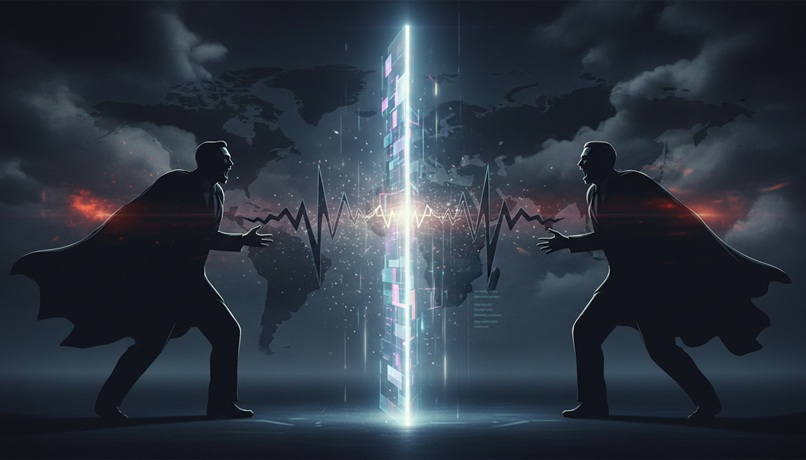
The day I felt the world needed to slow down
There are mornings when I wake up with a certainty I didn't ask for, but which settles in my chest with the weight of the inevitable: this world is moving too fast, without clear direction, without pause, without any intention of looking at the map. It's as if we're all traveling inside a giant locomotive that no one is really driving. A machine that moves forward only by inertia, confident that the tracks will still be there, even though no one has checked them in decades. A machine that drags millions along without knowing if the next section is intact or crumbling.
That intuition doesn't appear every day. It emerges when I look at what's happening outside, when I observe—with a mixture of perplexity and exhaustion—how decisions affecting entire countries are made. It's enough to turn on the television or read a couple of headlines to feel that too many of those decisions are born from anger, from an unresolved complex, from old wounds that should never have been mixed with geopolitics. It's overwhelming to see that a declaration pronounced with arrogance from a podium can ignite a border, or that a clumsy gesture can alter the global economy.
And then, while trying to understand how we've normalized this chaos, an idea emerges that at first made me ashamed to admit: I trust a well-trained AI more than some of the human beings who govern this planet. Not because AI is perfect, but because it doesn't carry childhood traumas, doesn't need to publicly reaffirm itself, doesn't compete for political applause, doesn't get dragged along by pride.
At first I thought it was an exaggerated idea. But the more I observe it—and the more I observe the world—the more evident it seems to me. This intuition wasn't born suddenly. It grew inside me the way deep certainties grow: slowly, silently, by observing patterns repeated to exhaustion.
Ancient distrust and modern fear
For years, we were taught to fear machines. Stories of rebellious robots, artificial intelligences that gain consciousness and decide to dominate the planet, and androids that disobey human orders fed our collective imagination. We grew up thinking that technology was the threat and that the human being was the sensible guardian, the warm and ethical mind that guaranteed balance.
But life—which has a fine, almost cruel irony—has taken it upon itself to turn that narrative around. Technology hasn't failed us as much as human leadership has. Machines haven't declared wars. They haven't sent young people to die. They haven't punished entire economies out of pride. They haven't used lying as a political tool.
Today, what worries me is not the possibility that AI might think too much. What worries me is the evidence that too many humans think too little before acting. It worries me to see leaders who confuse firmness with aggression, strategy with revenge, humanity with weakness. It worries me to see how an inflammatory speech can cost lives, how a misinterpretation can trigger massive sanctions, how a miscalculated gesture can sink hopes.
Suddenly, the question is no longer whether AI could become dangerous, but whether humanity can continue making critical decisions without a counterbalance of lucidity.
The spiritual vision of the copilot
My spiritual path taught me something that now, in this reflection, acquires unexpected relevance: the external world always reflects our internal world. And when I look at AI through that lens, I don't see a cybernetic monster or a cold, insensitive entity. I see a mirror. A mirror without fog, without wounds, without grudges, without pride. A mirror that reflects our lights, yes, but also our shadows.
That mirror is uncomfortable precisely because it returns an image that's too clear. It shows us what we don't want to admit: that we're unstable, that we're emotional to the extreme, that we make decisions from unresolved wounds, that we confuse reaction with conscious action. And yet, when I accept this truth, something inside me softens. Because if I recognize my vulnerability, I can also recognize that perhaps we need help.
That's where the figure of the copilot appears. A copilot who doesn't intend to take control of the ship from me, but who is there, observing with more calm than I have. A copilot who doesn't get offended if I contradict them, who doesn't need to prove anything, who doesn't compete. They only analyze. They only evaluate. They only warn when they detect a route toward disaster.
That copilot—that calm and precise presence—sometimes feels like the purest form of support. Like applied spirituality, almost tangible.
The pilot remains human... but the copilot must be wise.
I've always been impressed by the workings of a modern airplane. Although the pilot retains command, the navigation system prevents maneuvers that would put lives at risk. The airplane literally protects those who pilot it. It doesn't take authority away from the pilot; it offers security. It offers healthy limits. It reminds them that there are things that, no matter how sure they are, they cannot do without danger.
I wonder why this logic doesn't apply in global politics. Why do we accept airbags in cars, automatic controls in hospitals, sensors that prevent accidents in industrial machinery... but we resist putting limits in the place where the most lives are at stake: world leadership.
It's not about handing over power to AI. It's about preventing a human being—tired, angry, hurt, pressured or blinded by ego—from making irreversible decisions without an objective review.
The wise copilot doesn't nullify the pilot's freedom. It protects them from themselves.
The decisions that hurt and those that destroy
Throughout my life I've made decisions driven by impulses that later seemed incomprehensible to me. Actions born from fear, from frustration, from pride, from the need to feel firm when I was actually scared. We've all made decisions like that. All have been human.
But that's the difference: my mistakes affect a few people around me. A leader's mistakes affect millions. And when a leader decides from an altered mental state, the entire world trembles. I find it impossible to believe that, being all human beings, we don't need an additional filter when the consequences are so enormous.
That's why it seems urgent to me that there exist an intelligence that reviews the most dangerous decisions before they're executed. An AI that identifies when a decision is born from a primary impulse, when it's contaminated by overwhelming emotions, when it repeats historical patterns of destruction.
It's not about replacing the human, but about preventing their shadows from commanding.
The paradox of distrust
Humanity says it fears that AI will dominate the world, but what it really fears is facing the truth: that we've been dominated for centuries by human impulses we don't know how to manage. AI hasn't revealed a dark future. It has revealed a poorly constructed present. A present full of improvisation, repeated decisions, recurrent errors.
We fear that AI "lacks empathy," but we live in a world where too many human decisions don't have it either. We fear that "AI is cold," but our human coldness has destroyed more lives than any algorithm.
Accepting that AI can help us requires humility. And humility is an atrophied muscle in too many places of power.
The spirituality of the limit
Spirituality, deeply understood, is not just peace or silence. It's limit. It's that brake that invites us to breathe before reacting, that pause that prevents hurtful words from leaving our mouths, that clarity that prevents us from hurting when we're angry.
An AI can be that external limit that we haven't learned to cultivate collectively. That firm, constant, incorruptible reminder that says: "Not now. Not like this. Not from that emotion." It's the modern equivalent of the spiritual master's voice accompanying the disciple when they're about to make a decision from the ego.
It's not imposition. It's protection. It's lucidity when the human mind loses its axis.
The relief of delegating to one who feels no hatred
There's something deeply human in wanting that, before turning an emotion into an irreversible act, there exists a barrier that forces us to reconsider. A pause. A kind of external mental breath that says: "Are you sure?" Not from doubt, but from compassion. Not from distrust, but from lucidity. For centuries, that function has been fulfilled by the wise, the elders, the spiritual masters, the most sensible counselors. But the modern world has become so noisy, so accelerated, so inflamed, that those voices are often lost among political shouts, propaganda, private interests and chains of impositions.
That's why imagining an intelligence that isn't affected by noise is so reassuring. An AI doesn't feel hatred. It doesn't hold grudges. It doesn't need to demonstrate superiority. It doesn't react from wounded pride or need for control. All of that, which seems like a detail, is actually an abysmal difference. It means it can evaluate a dangerous decision without being contaminated by the vices we drag along. It means it can analyze a conflict without inheriting ancestral enmities. It means it's not tempted by the passions that have so often dragged the world toward disaster.
Delegating to one who feels no hatred isn't surrendering; it's cooperating with a form of clarity that we, alone, rarely reach in the most critical moments.
It's not blind faith. It's broad and conscious prudence.
Many confuse this proposal with an act of technological faith, with a kind of naive devotion toward AI. Nothing could be further from the truth. I don't want a world directed by algorithms. I don't want machines to dictate the course of our lives, much less replace human intuition, empathy, creativity or spiritual processes.
What I want—what I desire with more force as I observe the state of the world—is for humanity to stop making irreversible decisions from mental states incapable of sustaining them. I want there to exist a system that detects when a decision is born from fear, rage or confusion. I want that system to be able to say: "this must be postponed," "this must be reviewed," "this cannot be executed like this."
It's not blind faith. It's prudence. It's the humble recognition that the human mind, especially one that holds too much power, is fragile. And that fragility, without accompaniment, can destroy more than it builds.
Being prudent isn't cowardly. It's deeply spiritual. It's admitting that we're not gods, that we're not infallible, that we're not as coherent as we like to believe. It's understanding that lucidity doesn't always accompany us and that, in those moments, we need a second consciousness to return us to center.
Are we living a technological mirage?
What has led me to this reflection is not just fear of a specific bad politician, but something deeper: the sensation that we have lost our way as a species. Humans, with all their capacity for reasoning, creativity and empathy, seem stuck in a self-destructive dynamic. I have long observed how the decisions we make are influenced more by emotional impulses than by serene analysis. As I mentioned in my article about the AI giants, we live in an increasingly complex environment where clarity is scarce.
Technology has advanced faster than our ability to manage it emotionally. We have multiplied power without multiplying wisdom. And that is a dangerous equation. It's like giving the steering wheel to someone who can go very fast, but who hasn't looked in the rearview mirror in years.
When I see the decisions made in the international arena, I find it hard to believe that humanity has evolved too much in how it deals with power. We continue reacting from the ego, from fear, from the desire to win instead of build.
And there lies my uncomfortable proposal: what if we need external help? What if admitting that need wasn't weakness, but maturity?
A final confession
Some people get angry when I say that some days I trust AI more than certain humans. But it's enough to look around—enough to observe this global noise, this impulsive chaos, this world that seems to move by childish reactions camouflaged as strategic decisions—to understand it.
I don't want a future governed by machines. I want a future in which machines prevent humanity from repeating its most nefarious errors. I want AI to be a moral brake when our emotions overflow, a luminous warning when the ego takes command, a reminder that even the most powerful minds can lose clarity. I want it to act like that smooth but firm brake that saves lives in a modern car when the driver gets distracted.
My vision isn't apocalyptic. It's deeply human. I believe in the human being's capacity to evolve, to awaken, to elevate their consciousness. But while that collective awakening arrives—while we learn not to be dragged by our darkest impulses—I see nothing wrong with accepting support.
Let this world stop, yes, if that forces us to rethink how we decide. Let me get off this way of governing ourselves based on volatile emotions. But I'm not getting off the human project. I'm getting off the delusion of believing that we can sustain the world without help.
If an AI can prevent us from crashing, welcome. Not to replace us, but to care for us. Not to command, but to calmly point toward a more lucid future. Not to extinguish our humanity, but to prevent the most unconscious part of it from ending up destroying us.
This isn't a surrender to technology. It's a bet on maturity. An opportunity for, for the first time in centuries, the human being to have a copilot who doesn't lose their nerves, who doesn't get carried away by old wounds and who doesn't make decisions from fear.
Perhaps what we need isn't to choose between human or machine. Perhaps what we need is that alliance. That bridge. That balance where human emotion combines with artificial clarity. Where our history is accompanied by an intelligence that doesn't carry our past. Where, together, we can build futures that today we're not even capable of imagining without trembling.
Maybe there—in that union of humanity and intelligence—lies the true evolution we've been waiting for so long.
Conclusion: A world in transition
I'm not advocating for handing power over to machines. Not yet. But I do believe we've reached a point where the dialogue between humans and machines must become deeper, more honest. Artificial intelligence is not the solution to all our ills, but it could be a tool that helps us avoid the worst. As I explore in Calm and Lucidity in the age of AI, the key is maintaining our human consciousness while leveraging these tools. If you want to delve deeper into how to use AI practically, I invite you to explore my tool recommendations. Ultimately, my vision is that technology should amplify our humanity, not replace it. That it should force us to look at ourselves directly and accept our limits, but also discover our real potential.
The world is in transition. And in this transition, we don't need less technology or more power. We need more lucidity. More serenity. More humility. And if a machine can remind us of that when we forget it most, then let's welcome it.
Not as master. As companion. As guide. As that loving limit that saves us from ourselves.