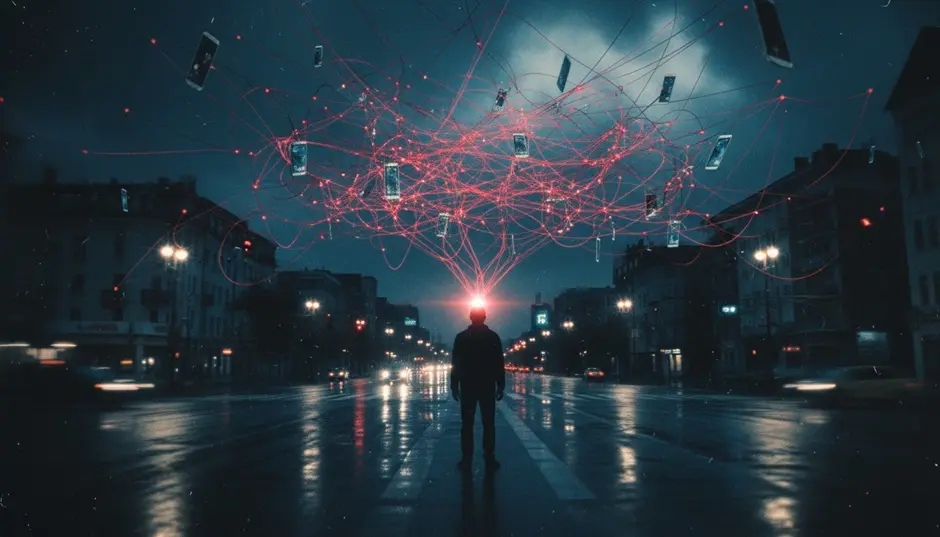
(Brief note): this is not about "proving" anything the way one proves a formula. It's about putting words to a very concrete human experience: that sensation when, suddenly, reality stops being noise and starts to rhyme. And when reality rhymes, one becomes still. As if listening.
There are times when everything happens as it should. Or, at least, as we usually understand it: one thing leads to another, causes push effects, and the unexpected gets quickly labeled so it doesn't disturb too much. "Strange things happen," we say, and move on.
But there are other times—and those who haven't lived it don't know what it's like—when the unexpected doesn't come alone, but chained together. It's not one rare fact. It's several. It's not one curious episode. It's a sequence. And in that sequence something very specific happens: you're not just surprised by what happens, but by how it happens. The feeling isn't "how strange," but "how well placed."
That's when the phrase usually appears, with the tone of a popular saying and a half-serious, half-ironic look:
"Coincidences don't exist."
Said like that, it's dangerous. Because it sounds like destiny. Like a script. Like someone, somewhere, is pulling the strings. And yet, it contains some emotional truth: when a coincidence shakes you, it doesn't shake you because of statistics, but because of meaning. It shakes you because it seems to say: "this concerns you."
What interests me is that intermediate zone between superstition and cynicism. Because cynicism is also a superstition: the superstition that everything is chance without possible meaning, and that sense is just a story the ego invents to feel important.
Between "everything is a sign" and "everything is noise" there's fertile territory. A territory where coincidences can exist and still be meaningful.
Jung: synchronicity, meaning and the secret language of coincidences
When Jung is mentioned, many people think of dreams, symbols, archetypes and that idea of the "collective unconscious" which, depending on who says it, sounds like deep psychology or incense from an esoteric shop. But Jung had a concept that, for me, is even sharper: synchronicity.
Synchronicity, as Jung presents it, is a coincidence that occurs outside and fits disturbingly with what's happening inside. Not because one thing causes the other, but because both seem to touch the same theme. As if the outer world and the inner world shared, for an instant, a language.
Jung described it as a "principle of acausal connection." Translated into human terms: there are connections that aren't sustained by the cause-effect chain, but by the meaning-resonance chain.
And here it's worth slowing down, because this concept gets ruined when it becomes a slogan. Jung wasn't saying "the universe sends you signals via instant messaging." He was trying to describe a real psychological phenomenon: the way certain coincidences become especially meaningful when you're going through moments of intensity, change, loss, decision, rupture, or rebirth.
What interests me about Jung is that he doesn't demand you believe. He invites you to observe. And, above all, he sets a healthy limit: don't confuse the psychological impact of a coincidence with the obligation to turn it into dogma.
Because this is where the human mind tends to slip. Classical rational explanation only breathes easy when it finds a cause. If there's no clear cause, either it's dismissed as mere coincidence, or it gets filled with a mystical story to avoid bearing the uncertainty. Jung proposes a third way: observe without closing.
Jung's secret manuscript: Liber Novus (the "Red Book") and why it was hidden for so long
To understand why Jung dared to speak of synchronicity and the collective unconscious with such certainty, there's a fact that illuminates everything: Jung didn't draw his ideas only from reading, theorizing, and classifying. Jung went inside.
And I'm not speaking metaphorically.
There exists an intimate, handwritten, beautiful and disturbing work that for decades was literally kept hidden: the famous "Red Book," whose original title is Liber Novus ("New Book"). Jung wrote and illustrated it himself, with calligraphy and paintings, as if he were crafting a codex.
The most important thing about this manuscript is not its aesthetics, but its function: it was the laboratory notebook of an inner confrontation. Jung went through a deep crisis after his intellectual break with Freud, and for years practiced what he would call "active imagination": a method for dialoguing with internal images, symbolic figures, and scenes emerging from the psyche.
Jung knew that this could be misinterpreted. It wasn't that he feared "seeming strange"; he feared losing credibility, feared being labeled crazy, or worse: that they would turn a psychological exploration into a circus. That's why he didn't publish it during his lifetime. It was too personal, too difficult to fit into the scientific language of his time and, above all, too easy to caricature.
The result was that Liber Novus remained unpublished for decades. After Jung's death, the manuscript continued to be guarded and restricted, and it wasn't until much later—when the cultural context could better digest it—that it was finally published in facsimile edition and translation. The publication came long after his death, and that's not a minor detail: it is, in itself, a clue to how aware Jung was of how delicate that material was.
In other words: the Jung we quote today in conferences and "serious" books has an intimate underground. A place where there is no theory, only experience. And from that underground, many things are understood.
Because when you see how Jung describes the encounter with his own shadow, with his contradictions, with his symbols, with his chaos... you understand that for him the unconscious was not a mental trash drawer. It was living territory, with forces that organize, push, confuse and also heal.
And when that territory is activated, the outer world starts to feel different. Not necessarily because the world changes, but because you change your place within it.
Collective unconscious: why, at certain moments, the world fills with relief
This is where synchronicity naturally connects with the famous collective unconscious.
When Jung speaks of the collective unconscious, he's not talking about a literal mental cloud, as if we were all connected to a spiritual server. He's talking about something much more sober and, for that very reason, more powerful: that humanity shares deep patterns of experience. That certain ways of living, fearing, loving, losing, fighting, and being reborn repeat over and over. That, although the settings change, the basic emotional script is surprisingly similar.
Jung called these patterns archetypes. Not as fixed characters, but as structures. Molds. Recurring forms of organizing experience.
When you're going through a stage of change, your mind seeks orientation. And many times it doesn't seek it with manual logic, but with symbolic logic. That's why in intense moments strange dreams appear, ancient memories, phrases that pierce you, songs that "coincidentally" speak to you, conversations that arrive at the wrong time but at just the right moment.
It's not that the world becomes magical. It's that your psyche is reorganizing your story, and in that process reality fills with relief.
There is born that sensation of "too much coincidence." And here comes the adult question, the one that doesn't seek fireworks:
Am I seeing a real pattern... or am I in a vital moment where every pattern touches me more?
There's no need to fear that question. The human brain is a pattern-detecting machine. It's its superpower. It's also its trap. We detect relationships where there are none, and that has a name. But the fact that we can deceive ourselves doesn't mean that every meaningful coincidence is self-deception. It means we have to walk with two flashlights at once: one for meaning, another for prudence.
A simple distinction helps me.
When a person falls into superstition, the coincidence becomes an external message sent by someone or something. When a person works with synchronicity maturely, the coincidence becomes an internal mirror.
The coincidence doesn't tell me "the universe wants this." The coincidence asks me: "why does this, now, affect me so much?"
In that question there is more freedom than in any dogma.
AI in the middle of the matter: perfect patterns, nonexistent meaning
Here contemporaneity enters like a kick through the door.
We live in a time when for the first time we have machines capable of detecting patterns on a scale no human can encompass. Artificial intelligence feeds on oceans of text, images, conversations, styles, symbols, stories, fears, and human promises. AI doesn't dream, but it has read millions of dreams written by others. It has no mythology, but it can recombine all mythologies. It has no biography, but it can imitate biographies.
And then something fascinating happens: the AI seems to "understand."
But here it's worth being honest. AI doesn't understand the way we understand. AI detects regularities. Predicts continuations. Finds connections. It works with cold logic: "this usually goes with this."
The risk appears when we, who are indeed creatures of meaning, start projecting meaning onto its patterns.
Because a meaningful coincidence can happen to you with life... and also with a system that returns exactly what you seem to need to hear at the moment when you're most vulnerable.
That doesn't make AI an oracle. What makes AI an oracle is our hunger.
In times of uncertainty, people seek certainty. And when a tool appears capable of generating plausible, convincing, and sometimes emotionally perfect answers, the temptation is gigantic: "if the AI says it, there must be a reason."
Here it's worth getting serious.
AI can amplify your clarity. It can organize ideas. It can help you see connections you weren't seeing. But it can also become a machine for reinforcing your bias if you enter looking for confirmation. It can give you exactly what you want to hear.
And if at that moment you're living a stage where "everything fits," the danger is double: confusing the fit with the truth.
Jung, with his dark humor, would probably say it like this: the most dangerous thing is not that meaningful coincidences exist. The most dangerous thing is that, thirsty for meaning, we hand over our judgment to the first pattern that caresses us.
Closing: perhaps coincidences exist... but so does meaning
I can't prove to you that the universe has a plan. And, honestly, I'm not interested in playing that game either.
I'm interested in something closer and more human.
I'm interested in the fact that our mind doesn't live only on causes. It also lives on meaning. It lives on stories. It lives on symbols. It lives on that precious and dangerous need for what happens to us to somehow fit together.
Jung gave a name to an experience that many have felt without knowing how to explain it. And he left, in a manuscript he himself preferred to keep hidden, a brutal clue as to why he took it so seriously.
We, a century later, have a new mirror: AI. An enormous, statistical, brilliant, and cold mirror.
It returns patterns to us.
But it doesn't return soul.
The soul—if we use that word without drama—appears when one decides to truly look, and not just seek confirmation.
And in that act, curiously, something changes.
Not necessarily the world.
But the way the world finds you.
Postscript for the reader who is experiencing "too many coincidences"
If lately you feel that coincidences are accumulating, don't rush to invent a religion for yourself. Nor rush to laugh at yourself to seem smarter.
Do something more useful: observe.
Let the coincidence ask you a question instead of giving you an answer.
And remember this: there may be no signs. But there may be a moment.
And sometimes, that's already enough.