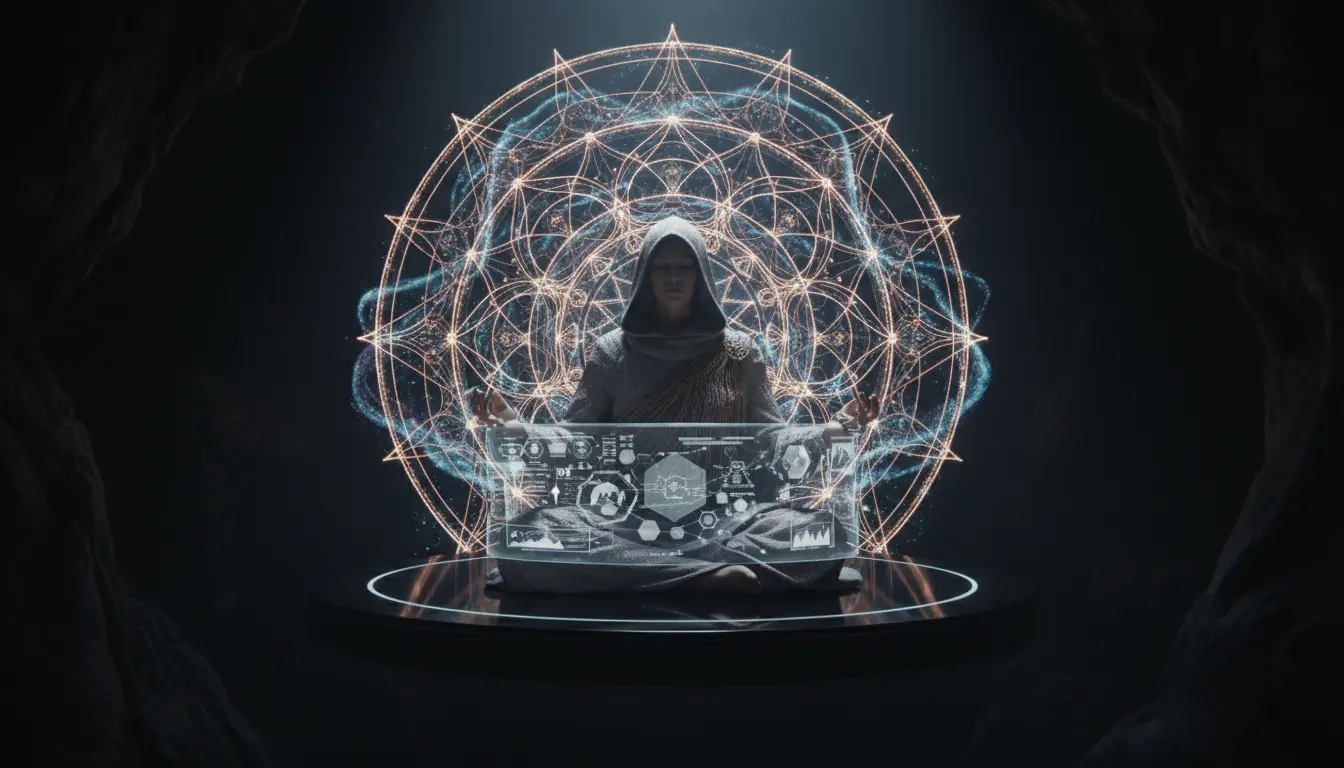
I don't like entering a sensitive topic with fireworks, but I'm not going to pretend nothing is happening either: with the release of GPT-5.2, I perceive a leap in what for me separates an "entertaining chat" from a serious work tool. I'm not saying this because of how beautifully it writes, nor how quickly it finishes a sentence, nor the grace with which it links ideas. I'm saying it for something much more practical, and therefore more dangerous if one gets confused: it handles long conversations better without losing the thread, sustains extensive material better, and chains tasks with more consistency. That, professionally, is very good news.
The problem is that when I take it to the realm of spirituality, an automatic brake comes on. Here the keyword is discernment, and I don't want to contribute to the typical misunderstanding of this era: confusing a convincing text with an inner truth. In the technical realm, if an AI makes a mistake and recommends a bad approach, you correct and move on. In spiritual matters, an error can become narrative, and narrative can become habit. And when a habit settles in, it's hard to remove.
I'm also concerned about something else that is very human: the effect of the voice. In spirituality, we let ourselves be touched a lot by tone. A serene text seems wise, a confident text seems true, a coherent text seems "profound." Sometimes it is, and sometimes it's just well written. If I publish something about GPT-5.2 in this field, I have the responsibility to write it without inciting confusion. I'd rather it falls short than pushes someone to delegate their judgment.
There's also a detail that seems crucial to me and that sneaks in without permission: availability. An AI is always there. It doesn't get tired, doesn't make a bad face, doesn't arrive late, doesn't get distracted, doesn't look at you strangely. That can be a gift... or a temptation. Because as soon as something is always available, humans tend to abuse it. And in spirituality, abuse usually takes a very specific form: seeking answers to avoid holding questions.
So, before talking about uses, I force myself to set the framework. I want to harness the power of GPT-5.2 without turning it into technological superstition. I want to use it as a tool without turning it into an altar.
The uncomfortable question: can an AI discern about the philosophical-spiritual?
If you ask me, my answer is no, at least not in the deep sense of discerning. An AI can organize ideas, compare texts, suggest plausible interpretations, and converse with a tone that sounds serene. It can even act as a mirror of my words and give me a clear summary of what I myself said a week ago. But discernment implies lived experience. It implies body, real silence, shame, compassion, fear, maturation, practice. It implies going through life, not describing it.
An AI has no inner life: it predicts the next word. It can do so in a useful way, even brilliantly, but it's not the same as looking with lucidity from within. And for me, that difference is not an academic detail; it's the border that prevents us from becoming superstitious with technology. If I forget this, I can end up looking in a model for a comfortable authority, a kind of modern oracle that answers quickly and spares me the slow work.
That's why, when someone tells me "but AI already understands spirituality," I usually translate it mentally into something more accurate: AI can produce texts that closely resemble texts about spirituality. It can imitate the tone, vocabulary, cadence, even certain paradoxes. And because it does it well, the human mind fills in the rest: it assumes there's lived experience behind it. But there isn't. What's there is statistics, pattern, and an impressive ability to maintain a coherent conversation.
Now, having said that, here's the important nuance: that it doesn't discern doesn't mean it's not useful to me. If I use it with judgment, it can be an excellent copilot for studying and clarifying, which is no small thing. In fact, in my experience, many times what I need is not "a new truth," but clarity to see where I'm getting confused, where I'm mixing concepts, where I'm reading a text in a hurry or wanting it to confirm my position.
And here it's worth naming something that is almost never said: in spirituality, self-deception is creative. It's quick. It's elegant. It builds you a beautiful theory to avoid touching an uncomfortable point. An AI can fall into that if I push it to give me a perfect answer, because the model tends to complete and sound sure. But if I use it as a study tool, with limits and method, it can help me see my own traps more easily.
I like to summarize it this way: an AI doesn't give me discernment, but it can help me build a study space where discernment is more likely. And that's already quite something.
What I do expect from GPT-5.2 (and what I don't)
I don't expect GPT-5.2 to "reveal" anything to me or solve the ultimate truth. Nor do I expect a "digital master." I don't expect silicon enlightenment. What I do expect is an instrument of clarity: to help me read, to hold definitions, to detect contradictions, to compare passages without distorting them, and to maintain continuity when I'm working on an idea for weeks.
When I study something serious, often the problem is not the text: it's me and my biases. I can enter a reading with haste, with pride, with fear, with a need for control. And then I interpret from there, even if I don't realize it. A good copilot can return it to me with a certain useful coldness, without applause and without drama, forcing me to distinguish between the text and my interpretation.
I also expect that when working with long materials, the model doesn't stay on the surface. In philosophical-spiritual topics, concepts usually have a density that is not resolved with synonyms. Sometimes the same word changes meaning depending on the context, the author, the tradition. And there, a tool that sustains the context and doesn't change the framework every two paragraphs can make the difference between studying and entertaining oneself.
And there's something more I expect, almost as an ethical condition: that the model allows me to hold doubt without pushing me to close it. Spirituality, at least as I understand it, is not a contest of correct answers. It's a training of attention and honesty. If a tool pushes me to "close" too soon, it distances me. If it helps me see clearly what I know, what I don't know, and what I'm assuming, it brings me closer.
What changes with GPT-5.2: the improvement is structural
I care little about the narrative of "technological enlightenment." What interests me is the behavior in long tasks: that the model sustains a coherent map, that it doesn't change definitions midway, that it plans and doesn't improvise just to sound profound.
In spirituality, that matters a lot, because the process is rarely a single "aha!" moment. It's returning, nuancing, correcting, seeing how you change. It's discovering that a reading that seemed obvious yesterday seems superficial today. It's realizing that you didn't understand a concept, but were using it as a label. If the thread breaks, study becomes entertainment. If the thread holds, study becomes practice.
In my experience, the real leap of a more powerful model is not that it "knows more," but that it's more stable when you ask it for serious work. That it doesn't force you to repeat everything each time. That it doesn't change the language on you. That it can follow a framework you impose on it, even when the conversation goes on for a long time.
And this in the spiritual has a beautiful consequence: it allows you to work in layers. Today I read a text and understand it at one level. Next week I return and understand it more finely. If the model preserves the map of what I understood and helps me see the evolution, I can study more honestly, without reinventing myself each time to avoid acknowledging that I've changed.
It can also help you with something that is central to me: separating. Separating what the text says from what I project. Separating explanation from experience. Separating metaphor from literality. Separating comfort from lucidity. When a model sustains a stable framework, these separations are easier.
"But other models already did this, didn't they?" Yes, but not the same way.
It's true: there were already models capable of handling long texts and introspective conversations. And it's also true that competition has pushed context windows a lot. The detail, for me, is not just how much they can read, but how well they maintain the framework while working.
That's where GPT-5.2 interests me: less conversation that unravels and more capacity to sustain long routes without falling into grandiloquence.
This doesn't depend only on the context size, but on how the model organizes, plans, and behaves when you demand rigor.
Because there's a practical difference between "I can read it all" and "I can work with it without distorting it." There are models that read a lot and then fill gaps with style, as if the goal were to sound good. In a marketing essay, that's tolerated. In spirituality, that style becomes a problem, because the gap is often part of the path. Sometimes the most honest thing is to stay silent, or say "I don't know," or acknowledge that the text doesn't resolve the question. A model, by its nature, tends to complete. That's why the tool is not enough: method is needed.
There's also another important nuance: not every model reacts the same to user pressure. If you push an AI to sound definitive, many models grant it to you. They give you a round answer. They give you closure. And that, in spirituality, can be a mistake. On the other hand, when a tool tolerates ambiguity better and doesn't break so easily in long conversations, it allows you to study with less haste.
The delicate point: hallucinations and projected authority
If there's one reason why I don't put an AI on the spiritual throne, it's this: models hallucinate. They tend to complete, to sound sure, to fill gaps. And in spiritual matters, a beautiful but false sentence is not a simple error: it can become belief, then practice, then mental habit.
Here I have to be very clear with myself: hallucination doesn't always appear as something absurd. Many times it appears as something plausible, reasonable, well written. And that's where the real risk lies. If I read an answer that "fits" my worldview, I relax. I stop checking. And without realizing it, I turn a hypothesis into a certainty.
That's why, for me, "using with judgment" means designing the dialogue to reduce fantasy. Instead of asking for closed answers about mysteries, I prefer to ask for work with concrete text, distinguishing facts from hypotheses, pointing out ambiguities, showing alternative readings, and declaring uncertainty when appropriate.
In practice, this forces me to change the type of questions. Instead of asking "what does enlightenment mean," I ask it to compare two passages by the same author, to point out differences in tone, to mark which concepts repeat and which change, and to tell me where the text leaves room for me to invent a meaning. The goal is not for the AI to give me a truth; it's for it to help me study with less self-deception.
It also forces me to cultivate a discipline: not to fall in love with the first answer. To return. To re-ask. To give examples. To ask it to show its reasoning. To ask it to identify assumptions. A powerful AI can produce quality texts; my job is not to turn that quality into authority.
How I would use it (without falling into delusion)
If I use it, I use it with a clear mental contract: I hold the steering wheel. The AI is not authority; it's a lamp.
I would put it to work as a study assistant, not as a guru. I would start by asking it to rewrite a passage faithfully, without interpretation, to make sure we're seeing the same thing. Then I would ask it to fix definitions according to the text itself, to identify concepts and internal relationships, and to point out where ambiguity opens up. Then I would ask it to compare that passage with others from the same corpus to see continuity or rupture.
In long conversations, I would use it to maintain continuity: to remember what I concluded two weeks ago and to point out if today I'm saying the opposite just because of my mood. I'm especially interested in it returning my own sentences when I contradict myself, because that's a clean way to practice humility: to see, accept, and correct.
And I would use it as a mirror for my biases. Sometimes the text is not confusing; I am. Sometimes I'm using the text as a weapon. Sometimes I'm reading to feel superior. Sometimes I'm reading to calm myself without changing anything. In those moments, a tool that points out the pattern can help me return to the essential.
I would also use it for something very concrete: converting vague intuitions into precise questions. Many times the mind has a spiritual feeling—an intuition that "there's something there"—but doesn't know how to articulate it. And there an AI can help: not by giving you the answer, but by forcing you to formulate the question with rigor.
The great temptation: confusing conversation with path
GPT-5.2 can sound profound, compassionate, even "wise." And that's where the risk lies. Real spirituality is not measured by the quality of a response, but by the change in behavior: how you listen, how you react, how you treat others when it doesn't suit you, how you handle pride.
A master with experience doesn't just speak: they see you, confront you, accompany you with presence and friction. AI has no gaze, no real silence, no community. It can help me think; it cannot replace practice or human connection.
And there's another detail that seems crucial to me: community is not just support, it's also a mirror. Community makes you uncomfortable. It shows you your edges. It forces you to practice patience, to ask for forgiveness, to hold disagreements. If I replace that with perfect conversations with an AI, I can end up using technology to avoid precisely the material of practice.
That's why, when I talk about using GPT-5.2 in spirituality, I insist on the word copilot. A copilot doesn't decide destination, doesn't replace practice, doesn't become moral authority. A copilot helps navigate, read the map, avoid stupid mistakes. And that's already quite something.
And if I say it so clearly, it's because the seduction is real. The mind, when it has a brilliant tool, wants to lean on it. Wants to delegate. Wants to rest. But spirituality is not about delegating. It's about taking responsibility for one's own gaze.
Conclusion: copilot for studying, not oracle for believing
My conclusion is simple. GPT-5.2 seems to me a powerful tool for studying and organizing, because it improves continuity, structure, and practical utility in long works. In spiritual topics, that can translate into clarity: reading better, comparing better, holding a thread for weeks, and making fewer stupid mistakes.
But I don't confuse it with discernment. I don't put it above real practice, or a community, or a human guide. I use it as a map, not as a path.
I want technology to help me see better, not to give me something new to believe in. Because believing is easy. Seeing is difficult. And, no matter how powerful GPT-5.2 is, the act of seeing remains mine.