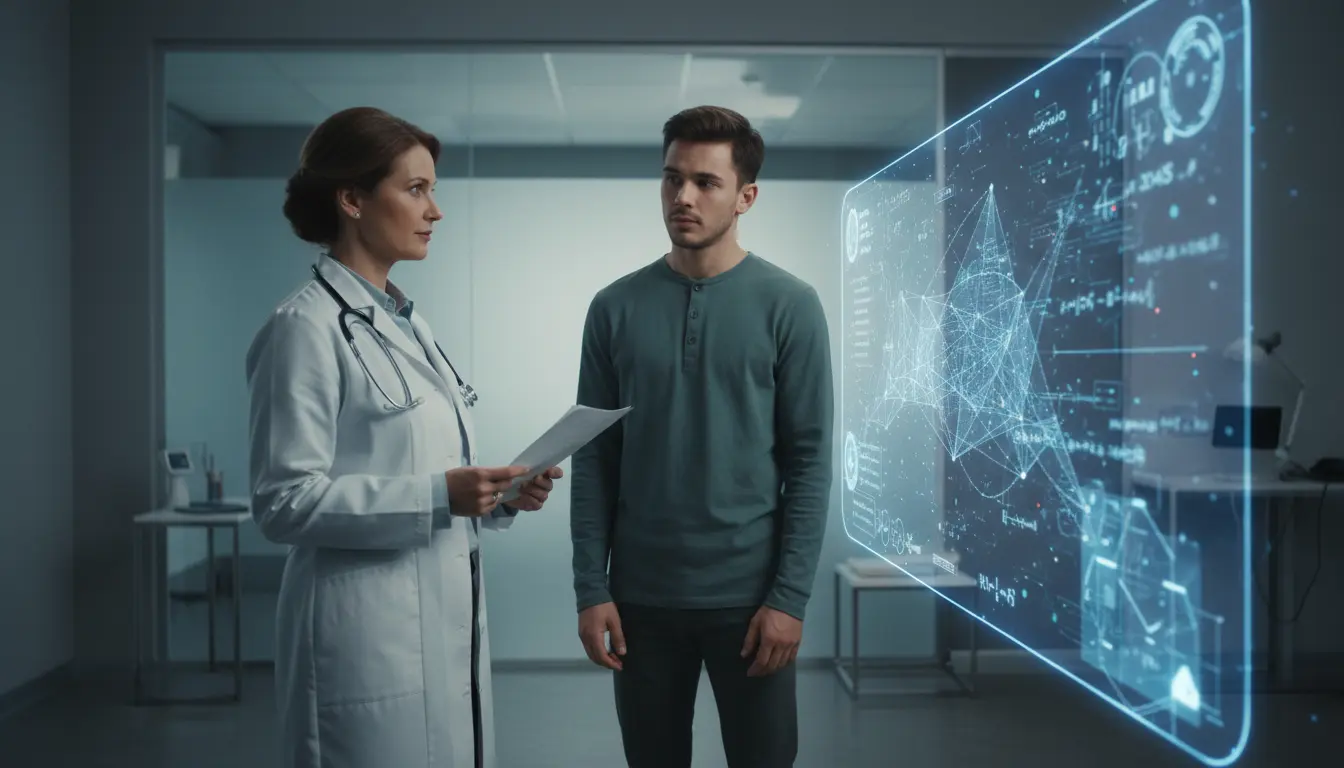
In May 2024, OpenAI officially presented ChatGPT Health, along with its parallel initiative OpenAI for Healthcare. I remember perfectly when I read the news: there were no fireworks, no grandiose headlines, no epic staging. And yet, I had a clear feeling that something important had just happened.
With that announcement, artificial intelligence was leaving behind relatively comfortable territories —productivity, creativity, education or programming— to dive headfirst into one of the most sensitive, intimate and complex areas that exist: human health. We're no longer talking about optimizing processes or gaining efficiency, but about coming into direct contact with people's body, mind, fear and vulnerability.
OpenAI wasn't starting from scratch. For some time now it has been evident that millions of people use AI systems to interpret symptoms, understand medical reports, clarify confusing diagnoses or make decisions related to their wellbeing. I myself have seen how friends and acquaintances turn to AI even before scheduling an appointment with their doctor. Until now, that use was informal, disorganized and, in many cases, lacking a clear framework.
With ChatGPT Health, OpenAI decides to take a step further: to order, channel and professionalize that use, creating a specific environment for health, with explicit promises of greater privacy, data isolation, clear functional limits and an idea that is repeated like a mantra: AI is here to support, not to replace.
The deployment, however, has not been global. In this first phase, ChatGPT Health is only available in certain countries outside the European Union, United Kingdom and Switzerland, mainly in the United States and other territories with more flexible regulatory frameworks. Europe, for now, remains on the sidelines.
And this data, far from being anecdotal, seems to me a fundamental clue to everything that is at stake.
My personal opinion starts from a clear premise: this can be a great advance, probably one of the most relevant at the intersection between technology and medicine in decades. But I also believe it's necessary to say it bluntly: it's not an innocent or purely altruistic move. There are clear economic interests, as there have always been in the healthcare field. Pretending otherwise would be naive. Pharmaceutical companies have been moving for decades in exactly that same unstable balance between business, innovation and health.
For me, the question is not whether there are interests. The question is what limits we set, what we give up as a society and what risks we are willing to assume when technological progress feeds on such deeply personal data.
This article revolves around two fundamental questions that, from my point of view, we cannot avoid. As I explore in stoicism applied to the AI era, we need mental clarity to navigate these advances.
ChatGPT Health: What It Is Exactly and What It Is Not
Before entering the ethical debate, I think it's important to stop and clarify the real framework of the project, far from both uncritical enthusiasm and easy alarmism.
ChatGPT Health is not officially presented as a medical diagnosis system or as an autonomous clinical tool. OpenAI repeatedly insists that it is a support assistant, designed to help people navigate an increasingly complex, bureaucratized and fragmented healthcare system.
According to what has been communicated, its main uses are:
• Helping to understand complex medical reports, full of technicalities. • Organizing and summarizing clinical records scattered across multiple documents. • Preparing medical consultations with better questions and greater context. • Analyzing lifestyle habits and general wellness patterns.
In some countries, the system can also integrate information from the user's own health data platforms, always under their explicit control.
From a legal and regulatory point of view, this distinction is crucial. By explicitly avoiding diagnosis and treatment, OpenAI remains —at least for now— outside the strictest perimeter of clinical health regulation, especially in the United States.
It's no coincidence. Language matters. And in health, it matters enormously.
The Current Legal Map: Why Europe Says 'Not Yet'
The legal situation of artificial intelligence applied to health is today fragmented, unequal and clearly transitional.
United States
In the United States, much of the debate revolves around HIPAA, the law that protects medical data in traditional healthcare settings. However, not all health applications are covered by HIPAA. Many tools aimed directly at consumers operate outside that framework, although they must comply with other regulations related to privacy and breach notification.
This relatively more relaxed context allows companies like OpenAI to experiment, launch products and adjust their models more quickly. It's an environment that favors innovation, but also transfers more responsibility to the end user.
Europe
In the European Union, the scenario is radically different. Health data is considered especially sensitive data under the General Data Protection Regulation (GDPR). Its processing requires very strict legal bases, clearly delimited purposes and reinforced guarantees.
Added to this is the European AI Act, which classifies many AI systems applied to health as high-risk systems, imposing additional obligations of transparency, human supervision and control.
That ChatGPT Health is not yet available in Europe is not a coincidence or a technical decision: it's a direct consequence of this much more demanding legal framework. Europe doesn't prohibit innovation, but subjects it to friction. And that friction slows down deployments and forces rethinking products and models.
Globally, the project is therefore in a phase of regulatory experimentation: allowed in some countries, observed under a magnifying glass in others and still without definitive fit in many places.
Do the Ends Justify the Means?
Here appears the first big ethical question that personally concerns me the most: is it worth sacrificing privacy in exchange for medical and health advances?
The promise is enormous. Artificial intelligence applied to health can help detect diseases earlier, reduce errors, relieve saturated healthcare systems and advance toward more personalized medicine. But to achieve this it needs data. And not just any data, but intimate, biological, emotional and behavioral data.
Centralizing medical records, lifestyle habits and health patterns can accelerate progress... but it also creates unique points of concentration of extremely delicate information.
Recent history has taught us that no system is infallible. The question is not only whether that data can be hacked or misused, but something deeper:
Are we willing to normalize our biological intimacy becoming a currency of exchange for progress?
We have already accepted something similar with pharmaceutical companies, insurers and public health systems. The difference now is the scale and inferential capacity. AI doesn't just store data: it crosses it, interprets it and draws conclusions that even we didn't know could be drawn. As I analyze in making better decisions in the AI era, the real challenge is maintaining our judgment against systems that seem to know more than us.
The Risk of Blurring the Doctor as Expert Figure
The second question is, for me, even more delicate. And it is because it has less to do with technology than with how we relate to authority, knowledge and trust.
I often wonder if there can come a point —and I suspect we're already close— where we stop seeing the doctor as the expert figure who truly understands, to start delegating that authority to a machine. Not because AI is malicious, but because it's comfortable, immediate and, apparently, safe.
Artificial intelligence is extraordinarily good at processing information, crossing millions of data points and detecting patterns that escape the human eye. In that sense, its power is unquestionable. But it's worth repeating, even if it's uncomfortable and goes against the general enthusiasm:
An AI doesn't understand. It calculates.
And this difference is not minor. Understanding implies context, experience, intuition, responsibility and, above all, awareness of consequences. Calculating implies correlating data, assigning probabilities and offering statistically plausible results.
A doctor doesn't just interpret an analysis or an image. A doctor listens, observes, asks, doubts, contrasts and, often, reads between the lines. They take into account the patient's life story, their environment, their emotional state, their fears and their silences. An AI, however sophisticated, doesn't accompany. It doesn't look into eyes. It doesn't perceive emotional contradictions. It doesn't assume moral responsibility for what it suggests.
The real risk is not that AI helps doctors. On the contrary: well used, it can be an extraordinary tool for improving diagnoses, reducing errors and gaining quality time for human care. The real danger appears when authority shifts. When the patient begins to trust a machine's response more than a professional's judgment.
AI as Copilot, Never as Pilot
I've already seen too many cases —and I suspect I'm not the only one— of people who arrive at a consultation with a practically closed diagnosis in their head because "the AI said so." The doctor, then, stops being an expert and becomes, at best, a validator; at worst, an obstacle.
Here the risk is double and deeply concerning.
On one hand, the medical act is impoverished, which stops being an exercise of clinical judgment to become an algorithmic confirmation. The healthcare professional may feel pressured, consciously or unconsciously, not to contradict what the machine suggests.
On the other hand, the patient's critical thinking is eroded, who may assume as objective truth what is still a prediction based on statistics. When we forget that AI works with probabilities and not certainties, the margin for error becomes invisible.
The greatest danger, in my opinion, is not technical. It's cultural. It's accepting without question that a neural network —however complex— can replace human understanding in an area where error, uncertainty and uniqueness are the norm, not the exception.
From my point of view, the only responsible position is clear: AI must be a copilot. And I say it without ambiguity, because I believe there's no room for half measures here.
When I talk about copilot I don't do it as a superficial metaphor. A copilot is not an ornament or a mere passive assistant. It's someone —or something— that provides information, anticipates risks, reviews data and helps make better decisions, but doesn't have the final word when circumstances become critical.
An extremely advanced copilot, capable of providing valuable information, detecting patterns invisible to the human eye, suggesting hypotheses and remembering thousands of clinical studies in seconds. All that is an unquestionable advance. But a copilot nonetheless.
The pilot must remain the healthcare professional. And not out of romanticism, but for reasons of responsibility, context and ethics. The doctor is the one who assumes the consequences of a decision, who answers to the patient, who integrates not only data, but experience, clinical intuition and human understanding.
The difference is subtle, but fundamental. AI can tell us what is probable. The doctor decides what is appropriate for that particular person, at that particular moment and in that particular life context.
When we confuse these functions we begin to slide down a dangerous slope. The risk is not that AI makes mistakes —humans do too—, but that we delegate moral responsibility to a system that cannot assume it.
I'm especially concerned about the temptation to use AI as a shortcut: as a way to compensate for lack of time, the saturation of the healthcare system or even professional insecurity. Turning the copilot into autopilot may seem efficient in the short term, but in the long term it dehumanizes medicine.
Medicine is not just a data science. It's also a profoundly human practice, crossed by uncertainty, uniqueness and fragility. And in that terrain, no system based solely on statistics and mathematics can replace human judgment. As I reflect in GPT-5.2 and spirituality, technology can be a spiritual tool, but it should never replace human connection.
That's why I insist: AI must accompany, alert, suggest and broaden the view. But the final decision must remain human. Confusing these functions would not just be a technical error. It would be an ethical and cultural error of enormous consequences.
The Silent Danger: Diagnoses Assumed as Truth
There is a particularly serious risk that I believe we are still not facing with sufficient seriousness: taking for granted diagnoses generated by a machine.
This risk doesn't manifest abruptly or spectacularly. It doesn't appear as a great systemic failure or an obvious collapse. On the contrary, it's a silent, progressive, almost invisible danger. It creeps in little by little into our habits, into our way of informing ourselves and, above all, into our way of interpreting authority.
AI works with statistics and probability. A lot of computational processing, yes. Increasingly sophisticated models, trained with huge amounts of data. But it still lacks real understanding. It doesn't know what it's like to be sick. It doesn't know what fear is in the face of an uncertain diagnosis. It doesn't understand the emotional weight of a misplaced word.
When we forget this, a probabilistic recommendation can become, for someone vulnerable or scared, a sentence. I've seen how a simple phrase generated by a machine can cause anguish, obsession or hasty decisions. And that's not a technical failure: it's a usage failure.
The problem worsens when context disappears. An AI doesn't know the patient, hasn't followed their evolution for years, doesn't perceive subtle changes in mood or contradictions in speech. However, its response can be perceived as objective, neutral, even scientific.
Here a particularly dangerous phenomenon occurs: we confuse statistical precision with clinical truth. And they are not the same.
Medical diagnosis has never been a simple sum of data. It has always implied interpretation, prudence, contrast and, in many cases, waiting. AI, on the other hand, tends to offer closed, well-formulated and convincing answers. And that appearance of security can be devastating when interpreted without the appropriate filter.
That's why I consider it fundamental to insist that no result generated by an AI should be assumed as definitive. Not because technology is useless, but because the error is not in the tool, but in the place we give it.
Conclusion: Progress Yes, Naivety No
The entry of artificial intelligence into the field of health can mark a before and after. Denying it would be absurd. I myself believe we are facing a historic opportunity to improve prevention, understanding of diseases and the efficiency of clearly strained healthcare systems.
But accepting this advance without critical spirit would be, in my judgment, a profound mistake. Not because technology is dangerous in itself, but because we tend to delegate too quickly what makes us uncomfortable to manage: uncertainty, responsibility and fear.
It's not about rejecting technology, or falling into apocalyptic speeches. It's about using it with judgment, understanding both its enormous potential and its structural limits. AI can expand our analysis capacity, but it cannot replace human judgment or moral responsibility.
AI hasn't come to replace humans. But it can if we allow it, if we give up thinking, asking and doubting. If we confuse comfort with truth and efficiency with understanding.
The real challenge is not technological. It's ethical, cultural and profoundly human. It has to do with how we educate society in the use of these tools, with what expectations we generate and with what lines we decide not to cross.
Perhaps, deep down, this discussion is not just about health or artificial intelligence. It's about something much broader: about our relationship with knowledge, authority and responsibility.
And that's why, for me, the final question is not what artificial intelligence can do for our health, but this:
What are we willing to give up, as a society, in exchange for this progress?
If you want to know more about my background and how I became interested in the intersection between technology, wellbeing and ethics, I invite you to explore my profile.